
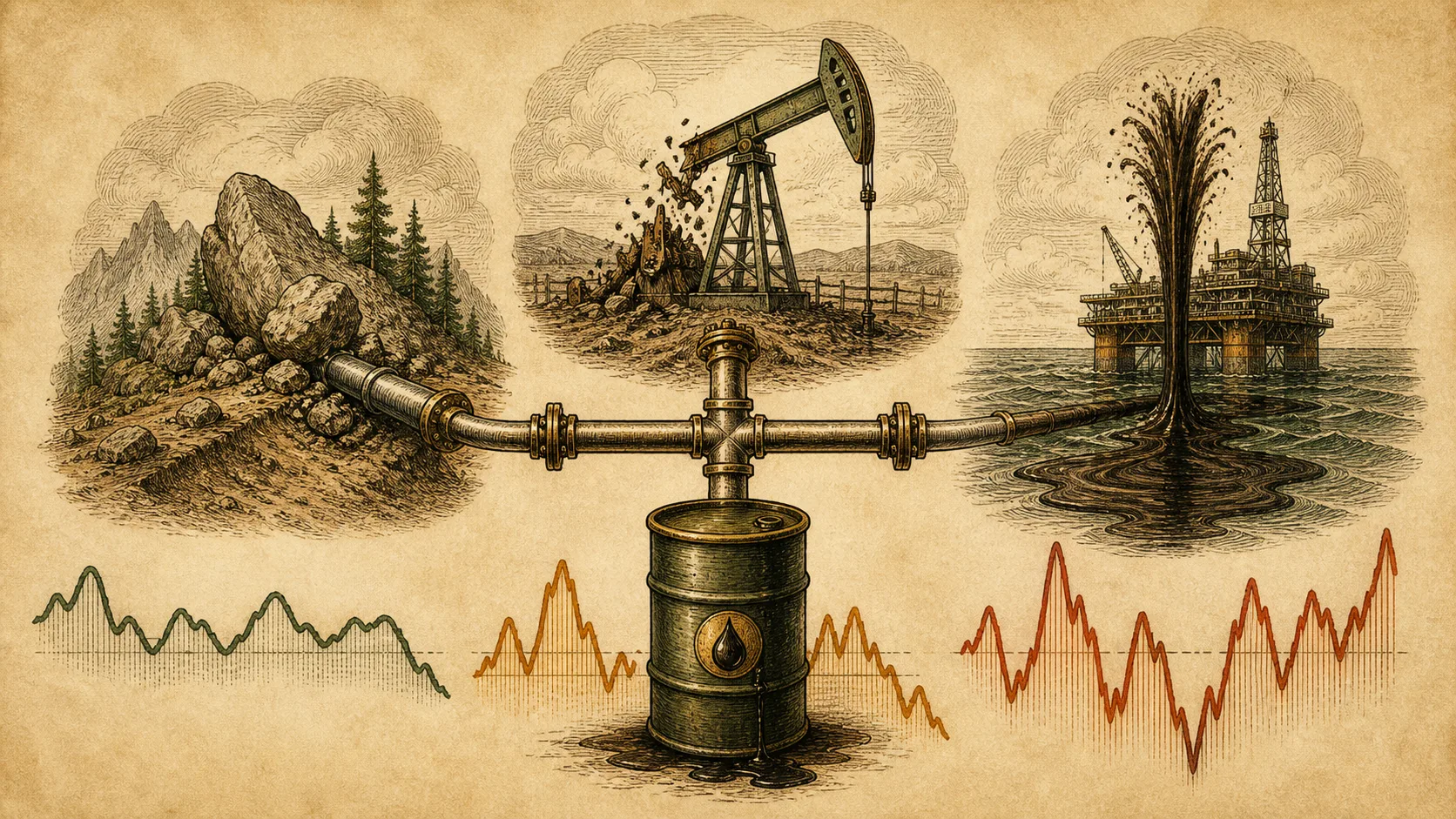
'Oil price shock' sounds like one event. In practice it is several different scenarios, each with its own transmission path and its own likely outcome: a shipping chokepoint at risk, a producer sanctioned, a demand collapse, or a recovery in expected flows.
Knowing which scenario you are in matters more than knowing that oil is moving, because the scenarios imply different answers to the same question: how long can this last?
Oil shocks travel through different scenarios: a supply disruption at a chokepoint, a sanctions-driven loss of barrels, a demand collapse, or an improving-flow outlook that unwinds a premium. Each has a different price path, and the key variable in every one is how much buffer exists in inventories, substitutes, and spare capacity.
Scenario 1: A Chokepoint at Risk
When a strait or major shipping route is threatened, oil prices jump on the fear of lost flows. The size and durability of the move depend on how much of the world's supply travels that route and how quickly alternatives can reroute.
If inventories are high and tankers can take other paths, the premium is likely to be smaller and shorter. If the route carries a large share of global barrels, the same threat prices in much more.
Scenario 2: Sanctions Cut Real Barrels
Sanctions against a major producer remove barrels from the market directly. The shock is more persistent than a headline because it is a physical loss, and price stays higher until replacement supply, inventory drawdowns, or weaker demand fills the gap.
The market watches spare capacity elsewhere and the speed of negotiations. If other producers can add barrels quickly, the impact is limited; if spare capacity is thin, prices can stay elevated longer.
| Scenario | Transmission | Typical path |
|---|---|---|
| Chokepoint at risk | Fear of lost shipping flows | Fast jump; can fade if flows recover |
| Sanctions cut barrels | Physical loss of supply | Persistent while the gap remains unfilled |
| Demand collapse | Less consumption of barrels | Prices fall broadly, often for months |
Scenario 3: Demand Collapse
Not all oil shocks are supply shocks. A global slowdown or a crisis that cuts travel and industry reduces the barrels actually consumed, and prices fall, sometimes sharply and for months.
Demand shocks matter because they can offset supply disruptions at the same time. In a weak economy, even a real supply loss produces a smaller price rise than it would in a boom.
The Fourth Path: A Premium Unwinds
There is also the recovery path: talks improve, expected future flows look better, and prices fall before the physical system is fully repaired. This is not a new shock; it is the market repricing the previous one.
The lesson of this path is that oil prices respond to the expected path of supply. A shock's price effect can begin to reverse while the bottleneck is still real, simply because the market now expects it to clear.
In every scenario the same question repeats: how much can inventories, substitute routes, spare capacity, and demand response absorb? The bigger the buffer, the smaller and shorter the price move.
| Scenario | Net exposure (hypothetical, vs. 100 million bbl/day global supply) | Hypothetical price-move range |
|---|---|---|
| Chokepoint threatened, mostly reroutable | 6 million bbl/day (6%) | Up 5%-15%, fading once transit resumes |
| Sanctions cut supply, spare capacity partly offsets | 1 million bbl/day (1%) | Up 10%-20%, persisting for months while the gap stays unfilled |
| Demand collapse, consumption falls and inventories build | 3 million bbl/day (3%) | Down 20%-30%, often for months |
These figures are a hypothetical scenario for illustration, not a forecast of any real event.
Converting the scenarios to a common baseline shows why the price reaction differs: with the chokepoint threatened, 12 of the 18 million bbl/day on that route can reroute, leaving a net exposure of just 6%. Sanctions remove real production directly; even after other producers use spare capacity to offset most of it, the remaining net gap tends to persist longer. The demand-collapse scenario's net exposure is closer to the chokepoint case than to the sanctions case, but because inventories are building at the same time rather than draining, the buffer becomes a drag rather than a cushion, which is why its price range is wider.
How to Use the Scenarios
When oil moves, name the scenario first. Then ask what the buffers look like and whether the market is pricing a current loss or a future probability.
A chokepoint scare with strong buffers argues for a fading move. A sanctions-driven physical loss with thin spare capacity argues for persistence. Naming the scenario is how you avoid treating every jump as the same event.
Frequently Asked Questions
Are all oil price shocks supply shocks?
No. Demand collapses and recovery repricing also move oil. Each scenario has a different transmission path and duration.
What determines how far a shock runs?
The size of the physical loss and the buffers that can absorb it: inventories, substitutes, spare capacity, and how much demand can respond.
Why does oil sometimes fall while the problem is still real?
Because prices reflect the expected future path of supply. When that outlook improves, the premium unwinds before the physical system is fully repaired.