
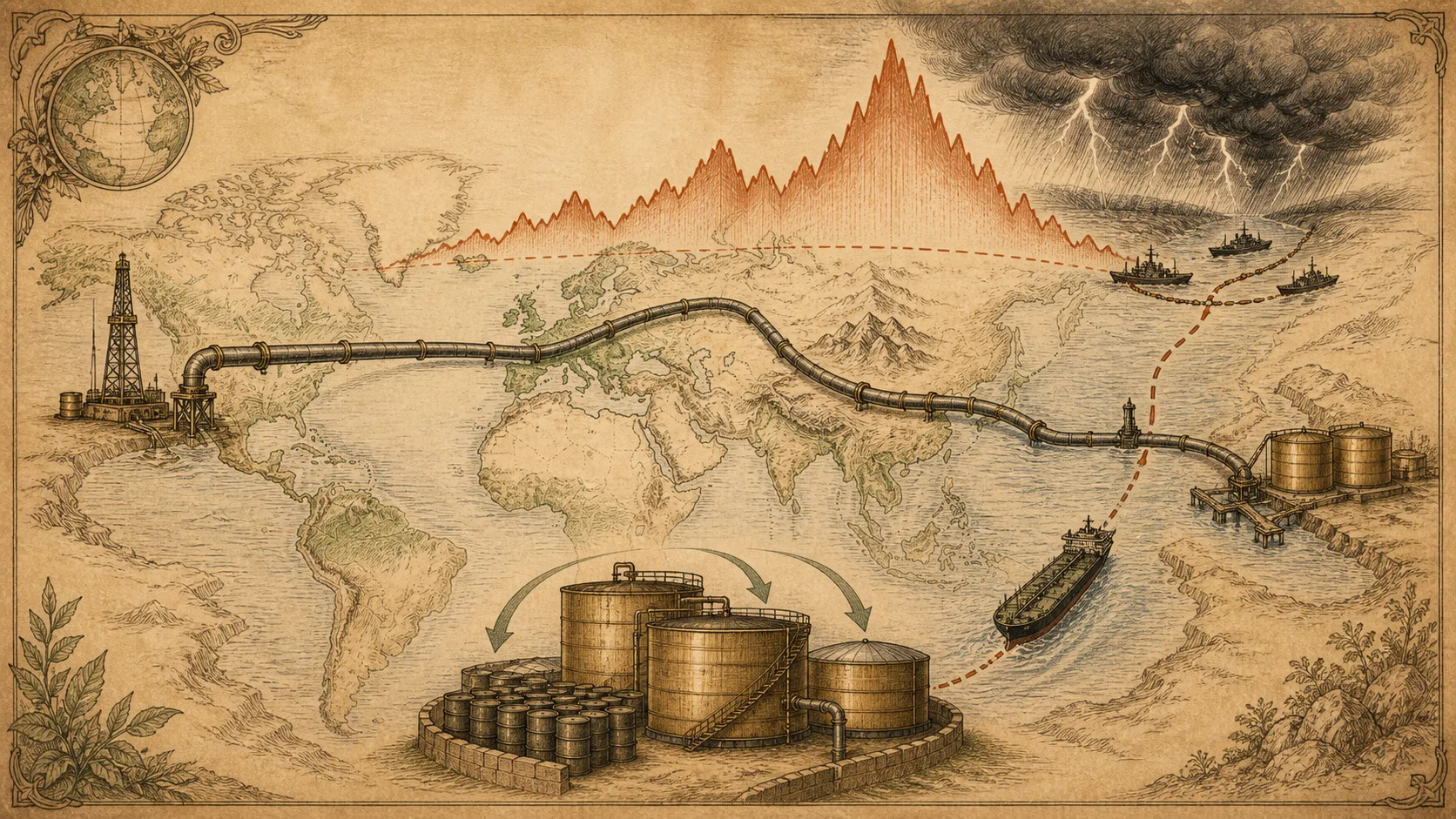
War headlines arrive and oil jumps. Traders call it the geopolitical premium. The name sounds simple, but the premium is not a fixed fee: it is a market opinion about the probability of a future supply disruption.
That is why the same premium can appear within hours and fade before the headlines calm. Understanding how it is built and unwound matters more than memorizing 'war means oil up'.
A geopolitical risk premium is the extra price buyers pay for the probability of a future supply disruption. It is built when conflict threatens physical flows and unwinds when the expected path of supply improves, which can happen before every bottleneck is repaired. Treat it as a market opinion, not a guaranteed price floor.
What the Premium Actually Is
Commodity prices reflect expected future supply, not just today's deliveries. When conflict threatens production, shipping, or a critical waterway, buyers pay more for barrels today because they fear barrels may be scarce later.
That extra amount is the risk premium. It is not a physical cost; it is a price for uncertainty. Its size depends on how likely the market thinks a real disruption is, and how hard that disruption would be to absorb.
How a Premium Builds
A premium grows when the market sees a credible path from a headline to lost barrels: a strait that could close, a port under attack, sanctions on a major producer, or a pipeline at risk.
The jump can be large and fast, because fear prices a worst case. But the same event does not produce the same premium twice: if inventories are high and substitute routes exist, the market may decide the disruption is unlikely or absorbable, and the premium stays small.
Why It Can Unwind Before the Problem Is Fixed
A premium unwinds when the expected path of supply improves, not when the physical system is fully restored. Talks resume, tanker traffic starts recovering, or traders simply decide the worst case is less likely.
This is why oil can fall while a shipping waterway is still constrained. The premium is an opinion about the future; when the opinion shifts, the price moves before the bottleneck disappears.
| Stage | Scenario | Brent price | Change vs. baseline |
|---|---|---|---|
| Baseline | Before the conflict breaks out | $80.00/bbl | — |
| Premium builds | Chokepoint-closure threat emerges; market fears a supply disruption | $88.00/bbl | +$8.00 (+10.0%) |
| Premium partly unwinds | Talks make progress, but the chokepoint has not actually reopened to normal traffic | $82.00/bbl | +$2.00 (+2.5% vs. baseline) |
These figures are a hypothetical scenario for illustration, not the actual price path of any real event.
Crude at a baseline of $80.00 jumps to $88.00 on a chokepoint-closure threat — an $8.00 jump built largely on fear. Once talks show progress and the market judges the worst case less likely, price falls back to $82.00, giving back $6.00, or 75%, of that jump — even though the chokepoint has not actually reopened to normal traffic. What is left in the price is just $2.00, or 2.5% above baseline: the market's estimate of the disruption risk that remains.
| Direction | What is happening | Typical price effect |
|---|---|---|
| Builds | Credible threat to production or shipping; low buffers | Premium grows, price jumps fast |
| Stays | Disruption partially absorbed by inventories and substitutes | Premium stabilizes, price pauses |
| Unwinds | Expected future flows improve, talks or traffic recover | Premium shrinks, price falls early |
| Returns | Disruption re-escalates after a recovery attempt | Premium builds again, price re-jumps |
It can be built on fear and unwound on a better outlook before any physical repair is finished. Treating the premium as a guaranteed floor is how traders get caught on the wrong side of an early reversal.
How to Think About It Before You Trade
Ask what a headline actually threatens: real production, shipping, or deliverable supply, or just sentiment? Then ask what buffers exist: inventories, substitute routes, spare capacity. A threat with no credible path to lost barrels deserves a small premium.
When you see a premium unwind, do not assume the danger is gone. The market has merely repriced the probability. Your job is to know whether the physical story still supports the premium or not.
Frequently Asked Questions
Is the geopolitical premium the same for every commodity?
No. It depends on how exposed the commodity is to the threatened flows and how much buffer exists in inventories and substitutes.
Does a big headline always create a big premium?
No. If the market judges the disruption unlikely or absorbable, the premium can stay small even for a dramatic headline.
Can the premium disappear and come back?
Yes. It is an opinion about future supply, so it can unwind on an improving outlook and rebuild if the threat re-escalates.