
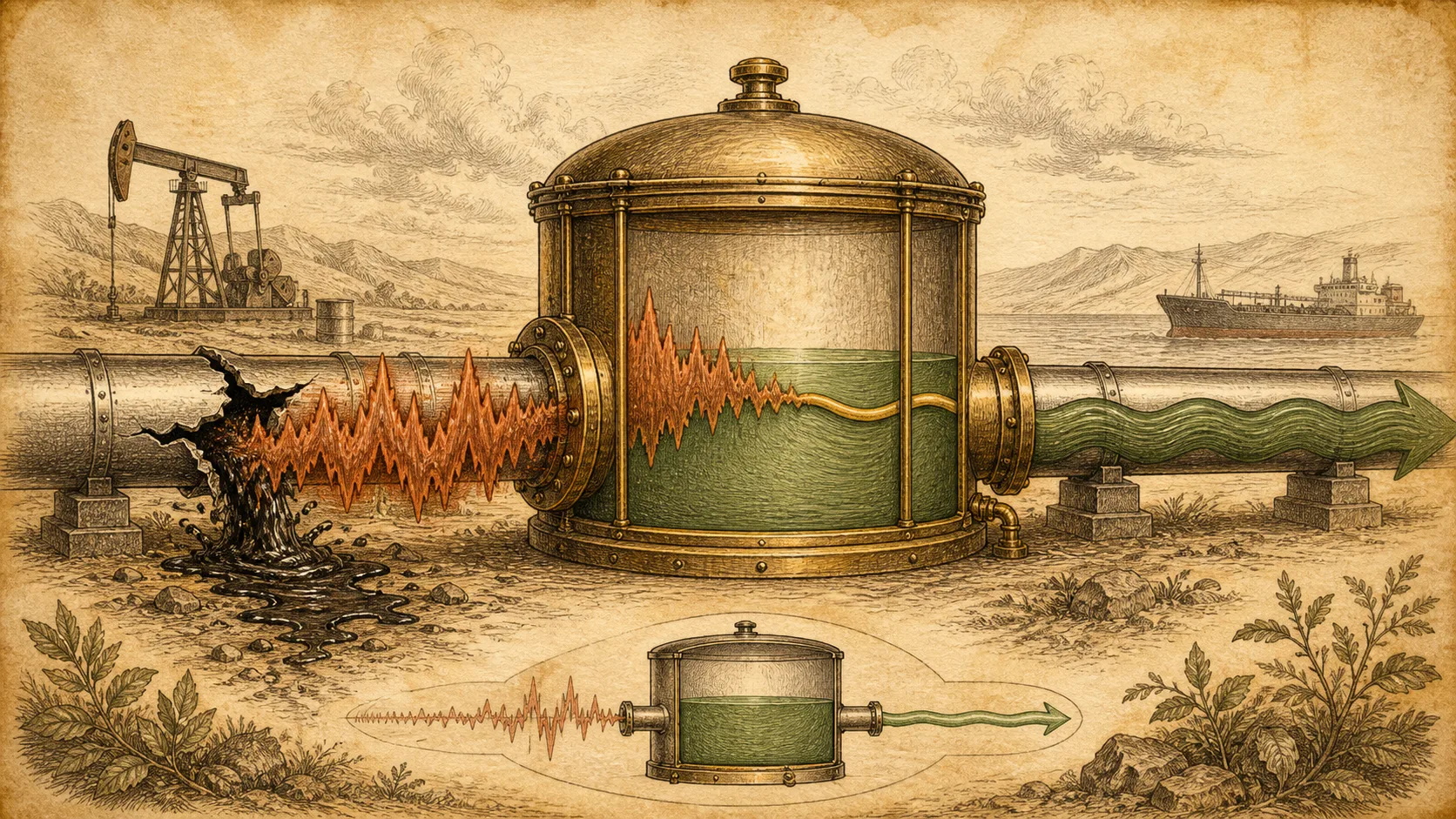
A geopolitical event threatens oil supply, and the price jumps. Whether the jump turns into a lasting shortage or a fading headline reaction depends on something the headline never mentions: how much oil is already sitting in inventories.
Inventories are the buffer between a disruption and a real shortage. They decide how long the system can bridge a gap before price has to do the rationing.
Inventories are stored oil that can be drawn down to bridge a temporary supply gap. High inventories let the market absorb a disruption with a smaller price response; thin inventories make the same disruption more urgent. The size and condition of stocks determine how much of a geopolitical shock reaches the price.
What Inventories Do
Inventories are the stored barrels that can be released when supply falls short of demand. A drawdown keeps the market supplied while the disruption is being repaired.
They turn a supply interruption into a temporary gap rather than an immediate shortage, buying time for the physical system to recover.
High Inventories vs. Thin Inventories
With high inventories, a disruption can be bridged: the market draws down stocks, and the price response stays smaller because the gap is being filled from storage.
With thin inventories, the same disruption has no buffer. Every lost barrel is felt in the spot market, so the price moves more and the shortage can persist longer.
| Inventory state | What happens | Typical price effect |
|---|---|---|
| High stocks | Drawdown bridges the gap | Smaller, shorter price move |
| Adequate stocks | Buffer covers part of the shock | Moderate move |
| Thin stocks | No buffer, spot feels every barrel | Larger, more persistent move |
| Scenario | Inventory available | Disruption size | Days of coverage | Survives a 20-day disruption? |
|---|---|---|---|---|
| Ample inventory | 15,000,000 bbl | 500,000 bbl/day | 15,000,000 ÷ 500,000 = 30 days | Yes, with 10 days of buffer to spare |
| Thin inventory | 6,000,000 bbl | 500,000 bbl/day | 6,000,000 ÷ 500,000 = 12 days | No, short by 8 days |
These figures are a hypothetical scenario for illustration, not actual inventory data from any real market.
A disruption that costs the market 500,000 barrels a day for 20 days creates a 10,000,000-barrel gap. A market holding 15,000,000 barrels of available inventory can cover 30 days — enough to bridge the 20-day disruption with room to spare. A market holding only 6,000,000 barrels runs out in 12 days; the remaining 4,000,000-barrel gap has no inventory to draw on, so it can only be closed by a price high enough to ration demand or pull in more supply. Same disruption, same size, but the inventory level decides how much of it ever reaches the price.
The same disruption is a headline in a high-stock market and a real shortage in a thin one. Check the inventory picture before judging how much a geopolitical event should matter.
Why It Matters for Trading
When a geopolitical headline hits oil, the first question is not just 'how big is the threat' but 'how much buffer exists'. Inventories are part of that buffer.
A high-inventory market can absorb a scare and see the premium fade quickly; a thin-inventory market can turn the same scare into a lasting price move.
How to Check the Picture
Look at reported inventory levels and trends for the relevant crude grade or region. Falling inventories ahead of an event mean less buffer; rising stocks mean more.
Combine the inventory picture with spare capacity and substitute routes: together they determine how much of a supply shock can be absorbed before price must ration.
Frequently Asked Questions
Are inventories the only buffer against a supply shock?
No. Spare capacity, substitute routes, and demand response also absorb shocks. Inventories are one part of the buffer.
Why does the same event move thin markets more?
Because there is less stored oil to bridge the gap, so every lost barrel is felt in the spot price immediately.
Can high inventories make a geopolitical scare fade?
Often. If the market can draw down stocks while flows recover, the premium can fade even while the disruption is still real.