
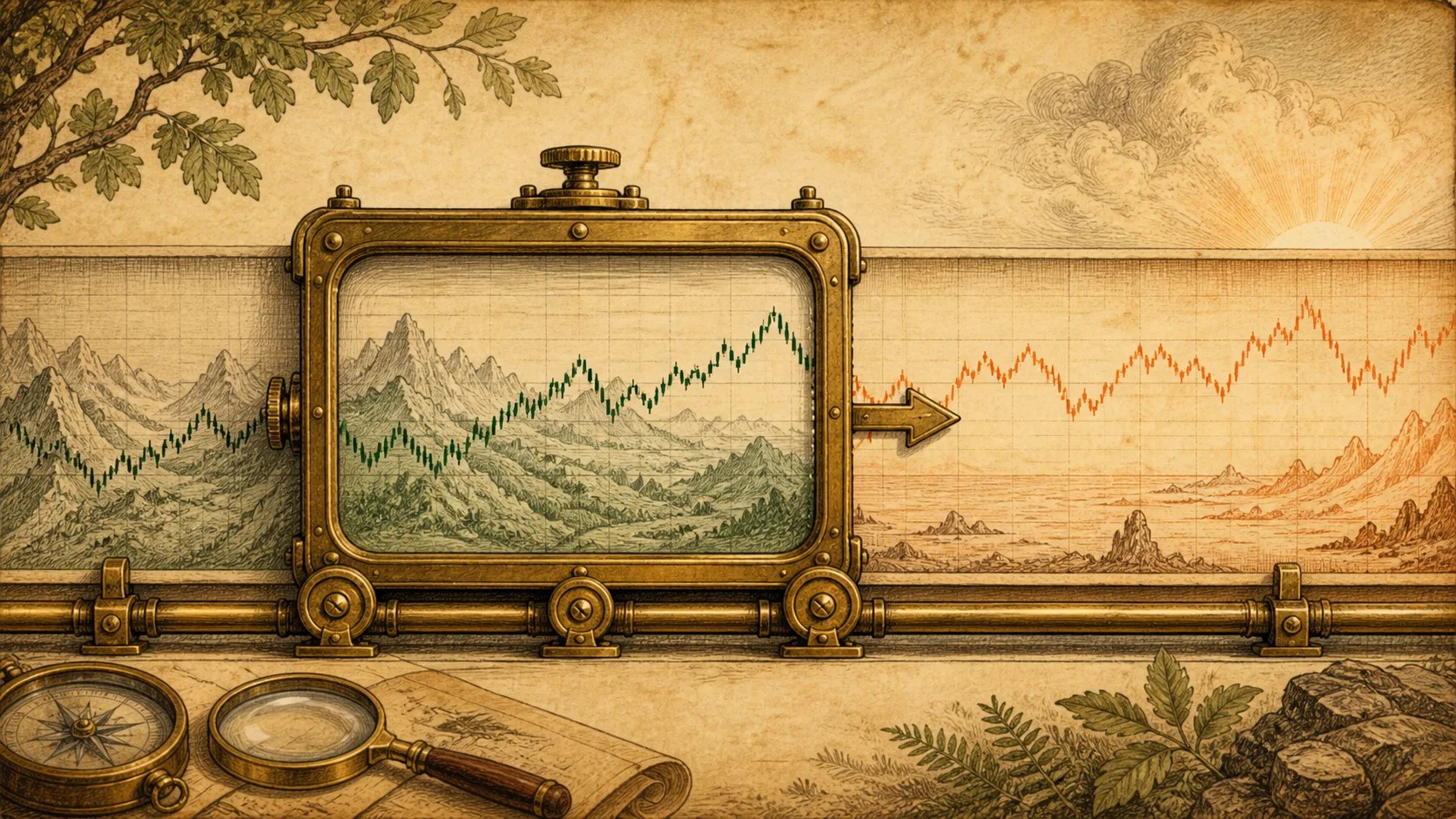
A backtest that fits one stretch of history beautifully can fail everywhere else. Walk-forward testing is a way to catch that before real money is involved: fit on one window, test on the next, then roll forward and repeat.
Because each tested period was never part of the tuning, the results carry more weight than a single in-sample fit.
Walk-forward testing fits a strategy on a training window, tests it on the immediately following out-of-sample window, then rolls forward and repeats. Because each tested period was never used in tuning, the results expose overfitting and carry more weight than a single in-sample backtest.
How Walk-Forward Testing Works
The history is split into consecutive windows. The strategy is fitted on the first training window, then tested on the next window it has never seen. The process rolls forward: each step uses the most recent data to fit, and the following window to test.
The result is a series of out-of-sample tests rather than one in-sample number, which makes overfitting much harder to hide.
| Dimension | Single in-sample fit | Walk-forward |
|---|---|---|
| Where parameters are set | On the full tested history | On training windows only |
| What is tested | The same data that was tuned | Windows never used in tuning |
| Overfitting exposure | Hidden in the fit | Exposed by the test |
| Result | One impressive number | A series of out-of-sample results |
Why It Exposes Overfitting
A strategy fitted to noise performs well only on the data it was tuned against. When walk-forward testing moves to a window that was never part of the tuning, a fit to noise stops working.
Consistent performance across the out-of-sample windows is stronger evidence than one in-sample number, because the pattern survived in periods the strategy never saw.
| Item | Single in-sample fit (50 trades, same history used to tune) | Walk-forward (3 windows, 100 trades combined, all out-of-sample) |
|---|---|---|
| Win rate | 60% (30 of 50 trades) | 44% (44 of 100 trades) |
| Average win | $350 / trade | $350 / trade |
| Average loss | $200 / trade | $200 / trade |
| Expectancy | +$130 / trade | +$42 / trade |
The same parameter set performs at $130 per trade on the history it was fitted to, then shrinks to $42 per trade once moved to 3 windows that were never used in the tuning.
The same parameter set earns $130 per trade on the 50-trade history it was tuned against, then drops to $42 per trade across 3 windows it never saw, 100 trades combined. That shrinkage is exactly what walk-forward testing is built to expose: a real edge would not fall this far apart from data it has never touched.
The Choices That Matter
The window sizes and how far the test rolls forward are choices, and they affect the result. A short training window has less data to fit; a long one can overfit differently.
The discipline is to fix the procedure before running it: window length, step size, and the number of steps are set in advance, not tuned against the results.
The entire value of walk-forward testing comes from the test windows being data the strategy was not fitted on. If the procedure leaks the tested period into the tuning, it is just a more elaborate in-sample fit.
Its Limitations
Walk-forward testing is not a guarantee. Each out-of-sample window is still from the same market history, and no procedure can prove a strategy will work in the future.
It is best used as a check alongside the other overfitting tests: parameter count, justification, sub-period consistency, and date sensitivity.
Frequently Asked Questions
Is walk-forward testing the same as a holdout period?
No. A holdout is one fixed out-of-sample period; walk-forward repeats the fit-and-test cycle across many consecutive windows.
Does passing walk-forward prove the strategy works?
No. It is stronger evidence than an in-sample fit, but it cannot guarantee future performance.
How many windows should I use?
There is no universal number. The procedure should be set in advance and should produce enough out-of-sample results to see a pattern.