
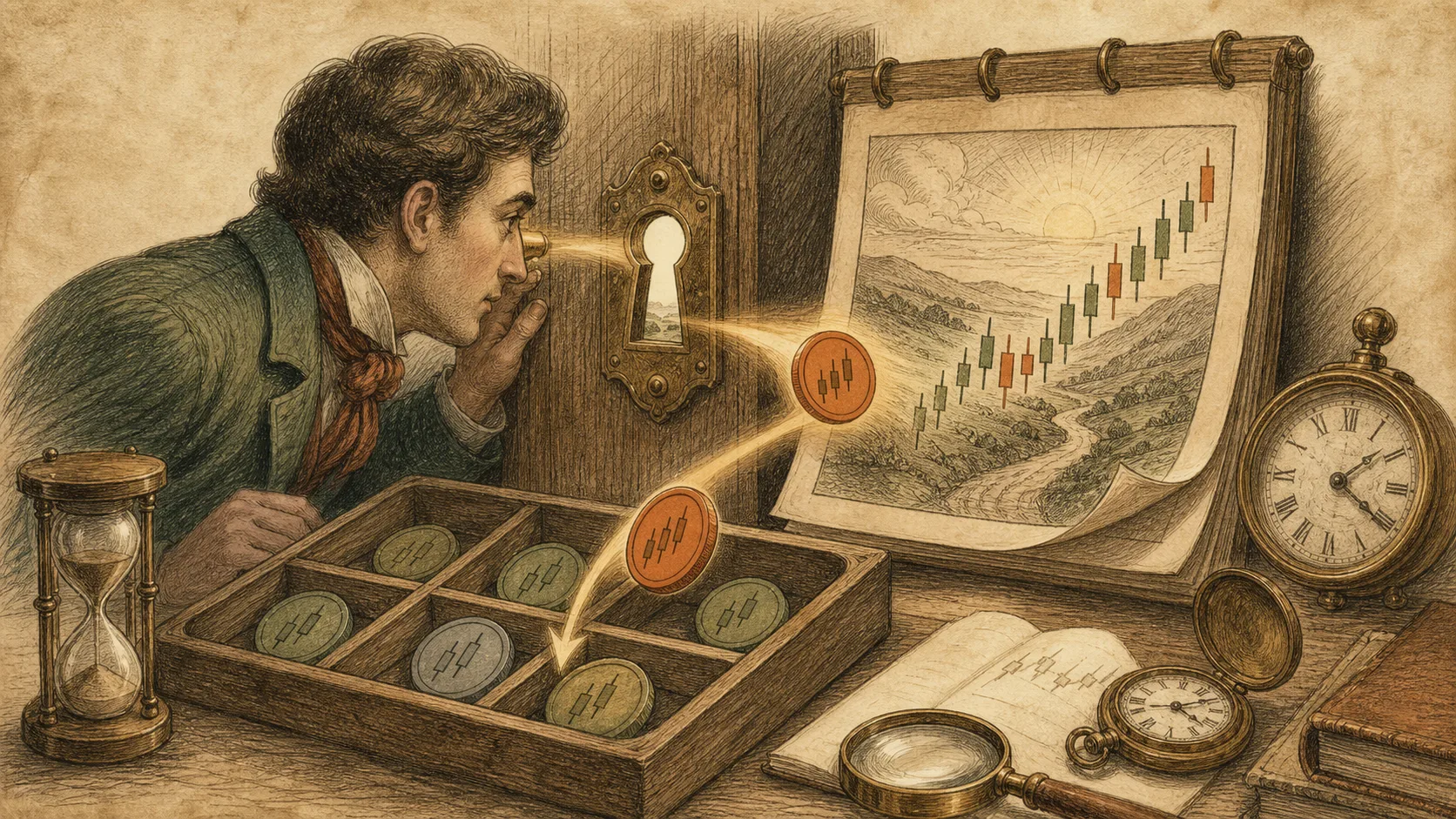
A backtest that looks fantastic may be cheating without meaning to: using a number that was revised later, a membership that changed, or a price that only became known after the moment being tested.
That is look-ahead bias, and it is one of the quietest ways a historical result can be better than what the strategy would have delivered live.
Look-ahead bias is using information in a test that was not available at the moment being tested. Common sources: revised financial figures, index membership that changed later, or future prices leaking into a signal. It inflates backtest results and is avoided by matching each data point's availability to the moment being tested.
What Look-Ahead Bias Is
A test evaluates a decision as if it were made at a historical moment. Look-ahead bias occurs when the test feeds the decision information that was not actually available at that moment.
The most common sources are data that was revised or published later: a financial figure that was restated, an index membership that changed, or a news timestamp that was earlier than the information became public.
| Source | How it leaks in | How to avoid it |
|---|---|---|
| Revised figures | Using today's restated number for a past period | Use the as-reported version |
| Future membership | Testing with companies added to an index later | Use the membership at the time |
| News timestamps | Assuming information was known before it was public | Match availability to the test date |
Why It Inflates Results
Information that was not available at the time gives the strategy a free advantage: it acts on knowledge that the real trader never had.
The inflated result looks like skill because the backtest is flawless, but the edge came from the future, not from the strategy.
| Item | Using later-revised data (look-ahead bias) | Using only data known at the time |
|---|---|---|
| Win rate | 64% (32 of 50 trades) | 46% (23 of 50 trades) |
| Average win | $400 / trade | $400 / trade |
| Average loss | $250 / trade | $250 / trade |
| Expectancy | +$166 / trade | +$49 / trade |
The same 50 trades — swapping the financial figures for the version actually visible at the time turns 9 of the 'wins' into losses, and expectancy shrinks to less than a third of its original size.
The same 50 trades: swap the later-revised figures for the version that was actually visible at the time, and the win rate drops from 64% to 46%, with expectancy falling from $166 to $49 per trade. The extra 9 'wins' depended on information the strategy could not actually have had at the time.
How to Check for It
For each input a test uses, ask when it actually became available. A revised figure should enter the test only after its publication date; a membership change only after it happened.
The practical check is timestamp discipline: every data point is dated by when it was knowable, not by the period it describes.
The bias is not in the data being accurate about what it describes; it is in the data being available earlier than it really was. A figure that is right about the quarter can still be wrong for the test if it was published later.
Look-Ahead Bias vs. Overfitting
Overfitting fits a rule to noise in the historical sample. Look-ahead bias hands the rule information it could not have had. Both make backtests look better than live trading, but they are different failures with different fixes.
Overfitting is fixed by testing on unseen periods; look-ahead is fixed by matching every input's availability to the test date.
Frequently Asked Questions
Is using the most accurate figure always right?
No. The most accurate current figure may not have existed at the test date. The test should use what was knowable then.
How common is look-ahead bias?
It is common enough to be a standard check in any serious backtest, especially with revised fundamentals or membership data.
Can I fix it after the fact?
If the data allows reconstructing what was knowable at each date, the test can be redone correctly. Without that, the result is not trustworthy.