
A
3 parameters or fewer
A small number of parameters relative to a typical dataset — easier to reason about and less prone to fitting noise.
Add enough adjustable parameters to any strategy and it will eventually fit its own test data perfectly. That perfect fit is often a description of noise, not a discovery of a real, repeatable pattern.
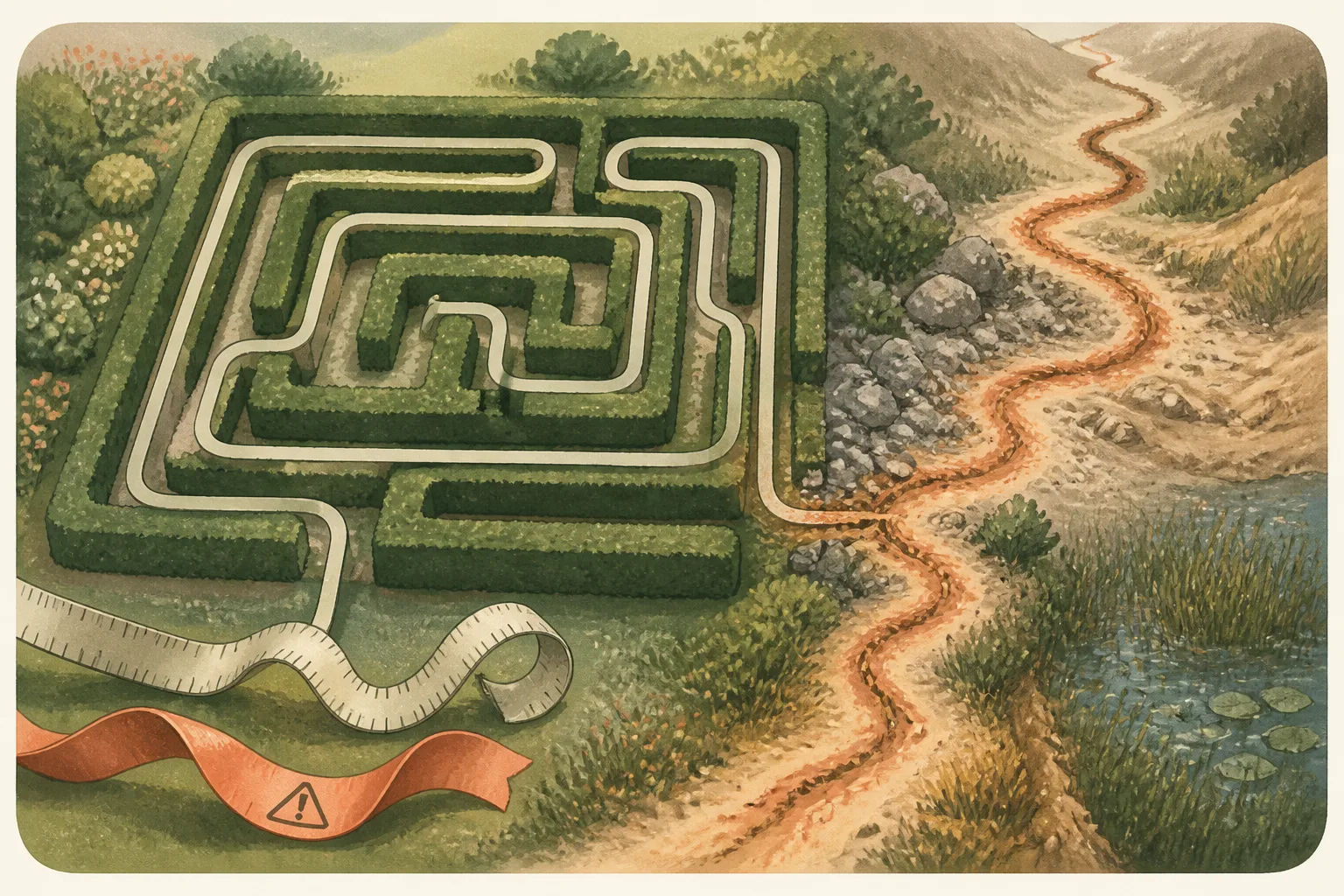
Overfitting occurs when a model or rule adapts too closely to the training sample and mistakes noise for repeatable structure. More search freedom creates more chances to find a lucky historical winner. Selecting a historical champion from many candidates creates data snooping.
This is explicitly a simulation: all 20 parameter sets are generated from noise and have no true edge. First see only in-sample performance and choose the one you would deploy; only then reveal out-of-sample.
Choose the parameter to deployEvery historical dataset contains some amount of pure noise — coincidental patterns that happened once and have no reason to repeat. A strategy with enough adjustable parameters can be tuned to capture that noise as if it were a real, repeatable edge. The result looks impressive on the exact data it was tuned against and often falls apart anywhere else.
Move the slider and read how a strategy with that many free parameters is typically regarded, relative to a standard amount of test data.
A small number of parameters relative to a typical dataset — easier to reason about and less prone to fitting noise.
A moderate number of parameters — worth checking performance across several independent sub-periods before trusting the result.
A large number of adjustable parameters — the more free parameters relative to the data available, the easier it becomes to fit coincidental noise rather than a real pattern.
A strategy whose performance depends heavily on the exact start and end dates chosen for the test — where shifting the window by a few weeks meaningfully changes the conclusion — is showing a classic overfitting warning sign. A strategy that performs consistently across several distinct, independent sub-periods is showing the opposite, more reassuring pattern.
Pick a case and judge whether it points toward a robust result or a warning sign of overfitting.
A researcher adds a ninth adjustable parameter to a strategy specifically because it improves the historical result by a small amount, with no other justification for including it. Adding parameters purely because they improve the historical fit, without independent justification, raises real overfitting risk.
A researcher tests a strategy with two parameters across two decades of data spanning multiple distinct market conditions, and it performs consistently across each sub-period. Consistent performance across multiple independent sub-periods is a stronger signal than a single aggregate result.
A researcher notices a strategy's historical performance depends heavily on the exact starting and ending dates chosen for the test. Extreme sensitivity to the exact test period is a warning sign that the result may reflect noise rather than a robust pattern.
How many free parameters were tuned, relative to the amount of data tested?
Was each parameter added for an independent reason, or only because it improved the fit?
Does the result hold up across several distinct, independent sub-periods?
Does shifting the test window slightly change the conclusion significantly?
Weigh parameter count against the amount of independent data available.
A pattern holding up separately in several periods is stronger than one aggregate result.
A robust pattern shouldn't vanish because the test window shifted slightly.
Submit your answers to see detailed explanations.
Describe how many parameters your strategy uses and how much data you've tested it on, and Mira can help you think through the overfitting risk — it won't tell you whether your specific strategy will work going forward.
Checking sign-in status...
Understand that a backtest applies rules to historical data to examine past performance and risk characteristics, but it can't prove future profitability, and ignoring costs overstates performance.
Build on backtest limitations from earlier in the course: data used to design a rule can't be the only evidence for it; a new time window that had no part in shaping the rule (out-of-sample, in beginner terms) is more valuable for validation; simulation, paper trading, and small-scale live observation each have their own limits. The core takeaway: evidence accumulates, certainty does not. Walk-forward, cross-validation, and Monte Carlo are out of scope.