
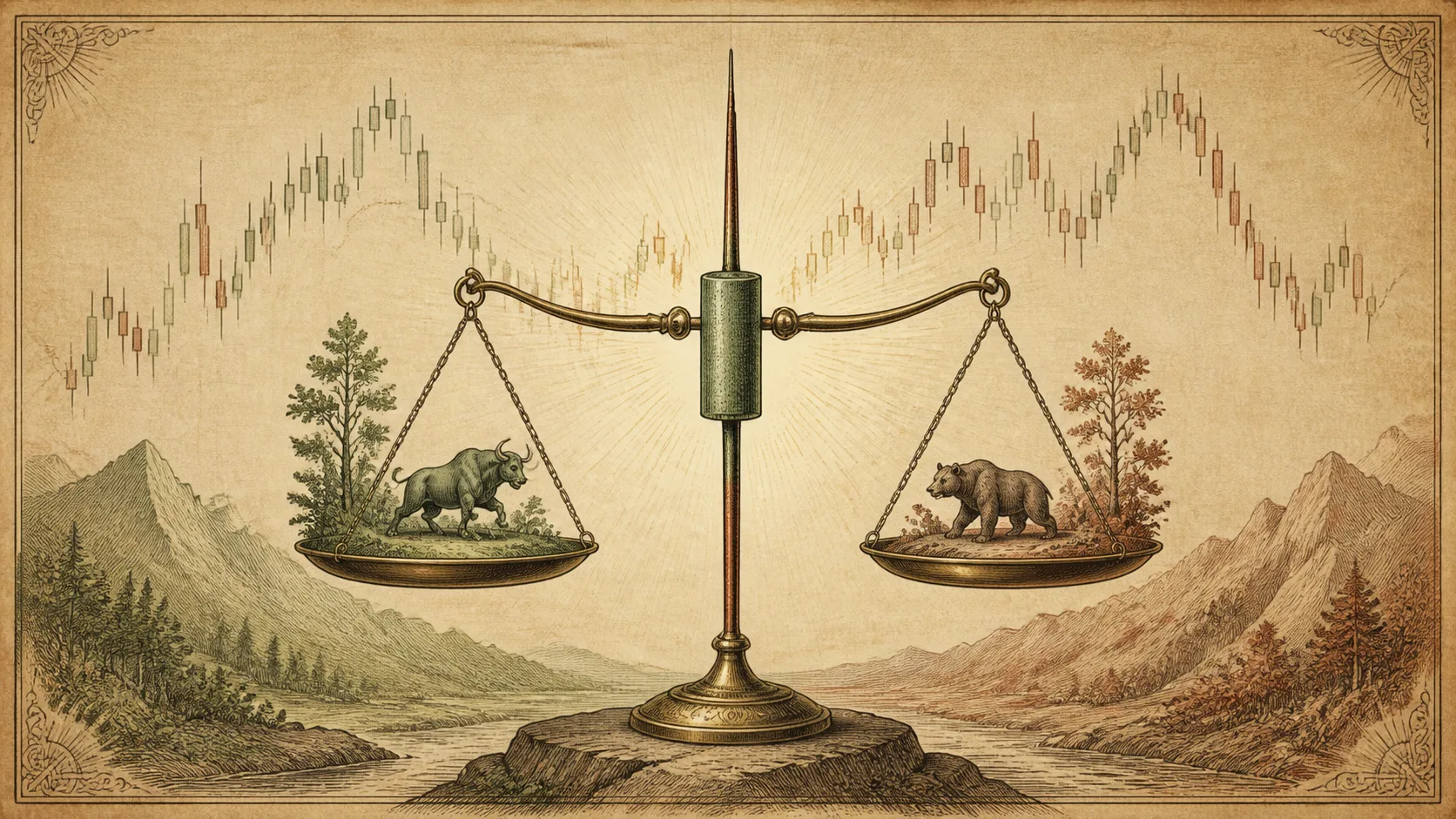
Most candles end with a clear body: buyers or sellers finished ahead. A doji is different. Its open and close are nearly the same, leaving almost no body and often long wicks on either side.
That shape is often read as a signal of indecision. The useful question is not 'is a doji bullish or bearish?' but 'what does a candle that ended where it started actually tell you?'
A doji is a candle whose open and close are nearly equal, producing a small body and often long wicks. It records a window where buyers and sellers ended about where they began, which is often read as indecision. A doji alone does not guarantee a reversal; its meaning depends on the market context around it.
What a Doji Actually Records
A candle is a summary of a window: open, high, low, close. When open and close are nearly the same, the body almost disappears, leaving wicks that show how far price traveled before being pushed back.
A doji records a window where buyers and sellers ended about where they started. It does not record a winner, which is why it reads as indecision.
Price traveled the full $1.80 between the day's high and low, but the close ended just five cents from the open — about 2.8% of that range. That is the textbook doji shape: a real fight happened, and the body barely shows it.
The Common Doji Shapes
A standard doji has small wicks on both sides. A dragonfly doji has a long lower wick and almost no upper wick. A gravestone doji is the mirror image, with a long upper wick.
The different shapes describe where the indecision happened: whether price was pushed down and recovered, or pushed up and rejected. The shape matters less than the context it appears in.
| Shape | What it looks like | What it records |
|---|---|---|
| Standard doji | Small body, wicks both sides | Price went both ways, ended flat |
| Dragonfly doji | Long lower wick, no upper wick | Selling absorbed, price recovered |
| Gravestone doji | Long upper wick, no lower wick | Buying rejected, price pushed down |
Why Context Matters More Than the Shape
A doji at a major support after a decline can mean something different from a doji floating in the middle of a range. The candle records the window; the surrounding structure decides what the indecision means.
A doji alone is rarely a reversal signal. It is a note that the window ended indecisively, which only becomes meaningful with context.
A doji records that buyers and sellers ended near where they began. That can precede a change or simply continue the current move. The candle alone does not decide.
How to Use a Doji
Treat a doji as information about the window, not as a standalone signal. Check the higher timeframe and the surrounding structure before reading it as bullish or bearish.
Combine it with the same discipline as any candle: judge by context, confirm with subsequent candles, and never let a single shape replace the plan.
Frequently Asked Questions
Is a doji bullish or bearish?
Neither by itself. It records indecision. Its meaning depends on where it appears and what happens next.
Does a doji guarantee a reversal?
No. It is a single candle that ended flat. Reversals need confirmation from context and following candles.
How is a doji different from a normal candle?
A normal candle has a clear body showing net direction. A doji has almost no body because open and close are nearly equal.