
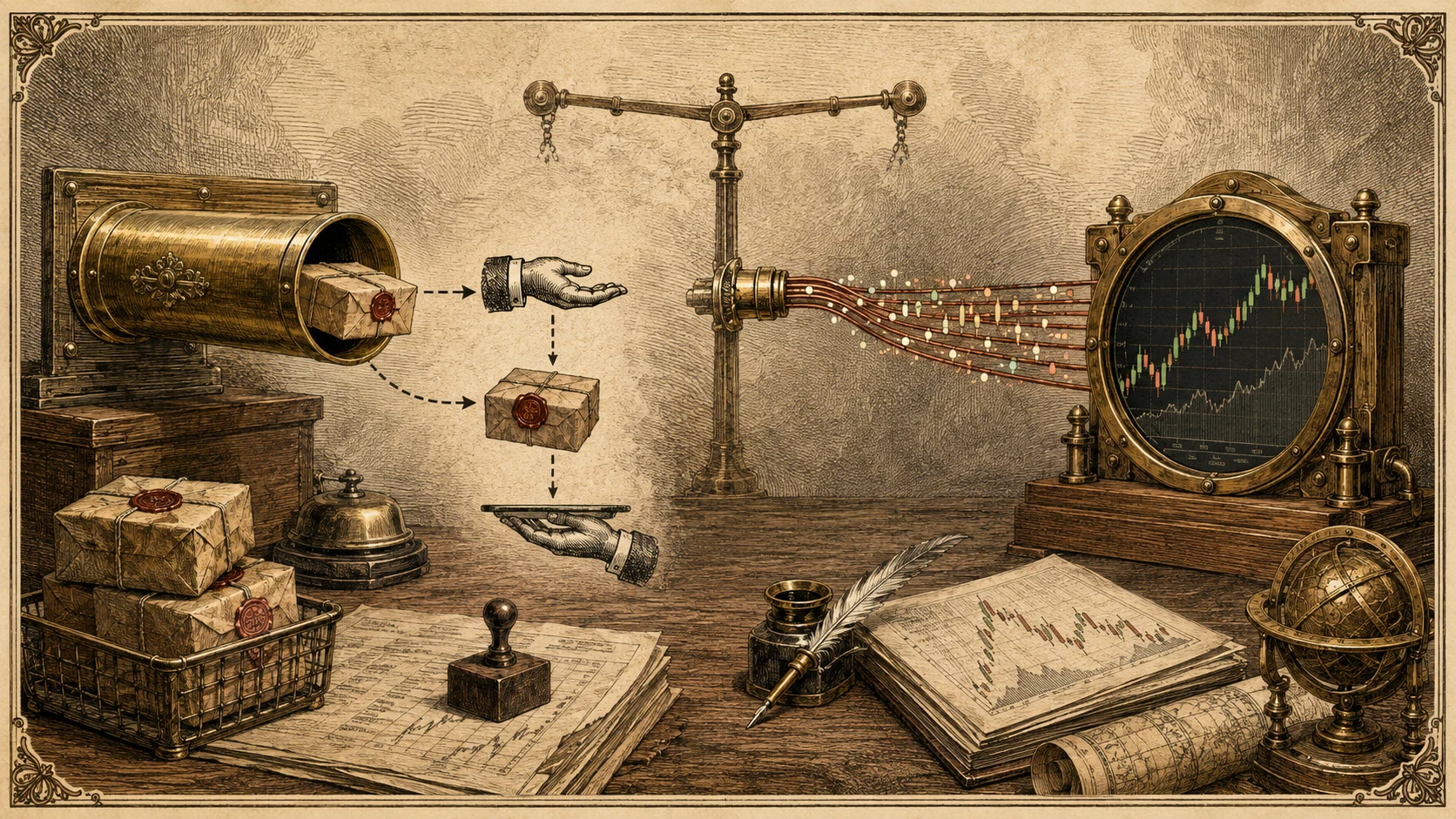
Imagine trying to follow a fast-breaking live event. You could manually refresh a news webpage every 10 seconds to see if a new headline appeared, or you could turn on a live audio broadcast where updates are pushed to your speakers the exact instant they happen.
That is the fundamental difference between a REST API and a WebSocket stream in market data architecture.
Beginner algorithmic traders frequently write scripts that bombard REST endpoints with rapid-fire polling requests, only to get banned by server rate limits or miss sudden price spikes. Understanding which protocol to use for historical research versus live execution is essential for building robust trading systems.
REST APIs operate on a request-and-response model: each logical interaction is a distinct request and response, while the underlying HTTP connection may be reused via keep-alive. It is ideal for downloading historical backtest data, fetching account snapshots, and placing infrequent orders. WebSockets establish a persistent, bidirectional connection over a single TCP socket where the exchange server continuously pushes live price ticks and order updates to your client. WebSocket is a common choice for streaming market data, though other real-time protocols also exist.
| Architectural Feature | REST API (Request-Response) | WebSocket (Persistent Stream) |
|---|---|---|
| Connection Lifecycle | Request-response per interaction (underlying HTTP connection may be reused) | Persistent bidirectional stream over TCP |
| Communication Pattern | Client initiates every interaction (Pull model) | Server pushes updates immediately as events occur (Push model) |
| Latency Profile | Sampling lag bounded by polling interval + network round-trip | Event-driven push (immediate transmission upon event occurrence) |
| Rate Limit Pressures | Frequent requests quickly exhaust exchange query quotas | Single continuous connection avoids repeated polling limits |
| Primary Trading Role | Historical bulk downloads, daily scans, manual order routing | Live price feeds, real-time stop monitoring, order book depth |
The Danger of Rapid Polling via REST
A common beginner mistake is attempting to track live prices by running an infinite `while` loop that calls a REST endpoint every 200 milliseconds.
This approach introduces two fundamental issues: Server Rate Limits and Sampling Lag.
Even when HTTP connections are kept alive, repeated high-frequency polling generates unnecessary request overhead and quickly triggers HTTP 429 (Too Many Requests) rate limits or IP bans. Even worse, if a market-moving event triggers a price spike between polling intervals, your system remains unaware of the price jump until the next poll completes.
Unlike REST where a failed request returns an immediate error code, a WebSocket connection can quietly die without closing the TCP socket (a 'half-open' state). Robust trading systems must implement automated ping-pong heartbeats and follow provider-specific heartbeat and reconnect rules to detect and restore stale connections promptly.
The Professional Solution: The Hybrid Data Pipeline
Institutional systems do not choose one over the other; they use both protocols in a coordinated pipeline:
- 11. Bootstrap State with REST: On system startup, use a clean REST request to fetch account balances, open positions, active orders, and the last 1,000 historical bars.
- 22. Maintain State with WebSockets: Open a persistent WebSocket stream to listen for real-time trade ticks, order book depth changes, and immediate fill notifications.
- 33. Periodic Reconciliation: Run a low-frequency REST audit (e.g., once every 10 minutes) to reconcile local memory state against exchange database truth.
Frequently Asked Questions
Can I place trading orders over a WebSocket connection?
Some modern cryptocurrency and futures exchanges allow order entry and cancellations over WebSockets for minimal latency. However, most traditional equity brokers still require order entry via secure authenticated REST or specialized FIX protocols.
What is the difference between delayed and real-time data feeds?
Free public REST endpoints often provide market quotes delayed by 15 minutes to comply with exchange licensing rules. Real-time feeds require direct exchange agreements or brokerage API keys.
Why do my WebSocket messages sometimes arrive out of order?
While TCP guarantees packet sequence, high-throughput market streams can buffer internally. Exchanges include sequential message sequence numbers (`seq_id`) so your application can detect dropped or out-of-order packets.