
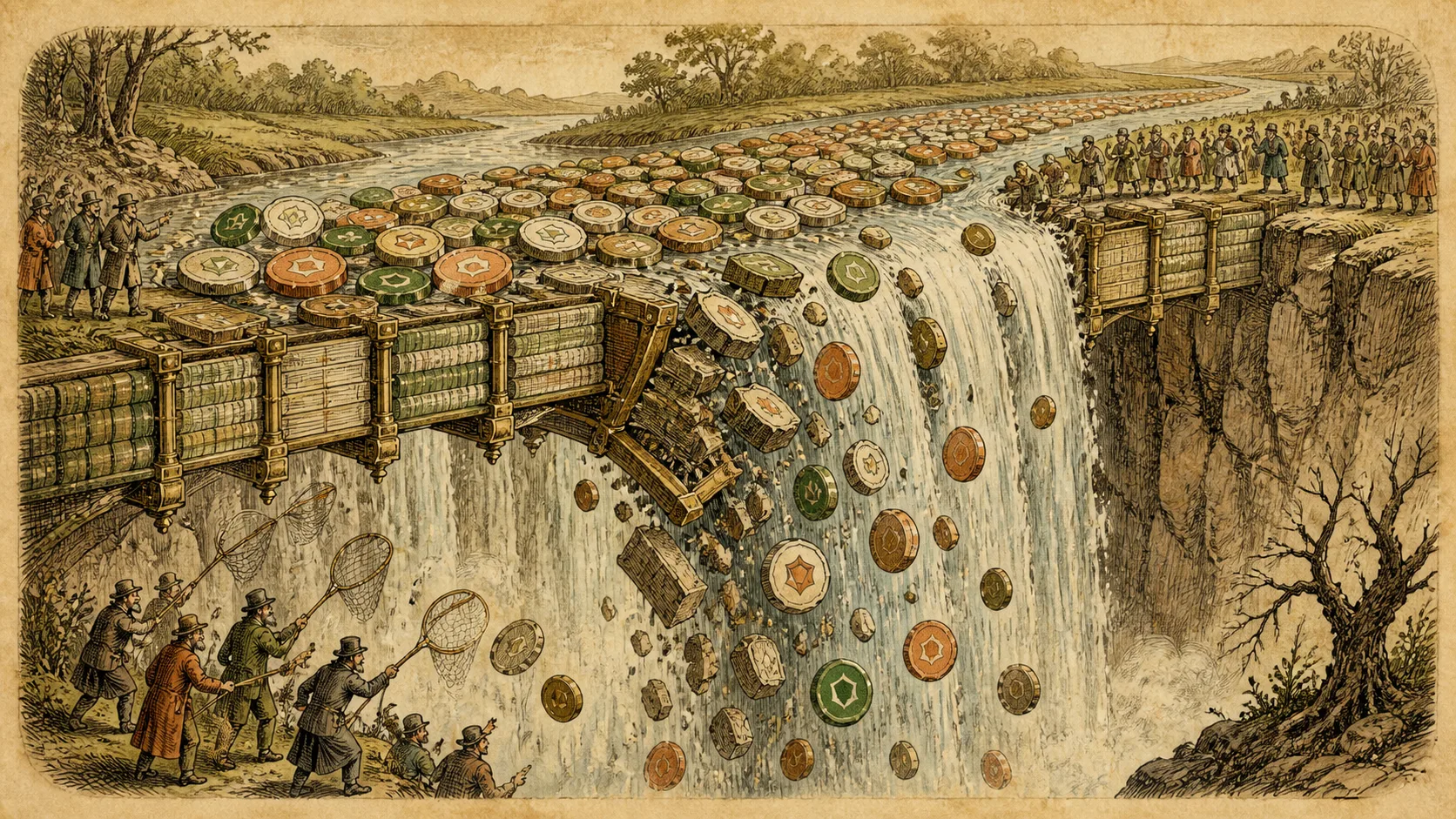
A flash crash looks paradoxical: the market is trading a huge amount of volume, yet the price is plunging as if no one is buying. Both are true at once.
The explanation is a liquidity vacuum: completed trades multiply while resting buy orders vanish, so even modest selling finds almost no depth and drops the price sharply.
A flash crash produces a liquidity vacuum because panic selling multiplies completed volume while market makers pull resting buy orders to protect themselves. The book empties even as trades mount, so a modest sell order drops the price sharply and stops fill far below trigger levels.
Record Volume and an Empty Book at the Same Time
Volume counts trades that already completed. Liquidity is the resting depth waiting in the book. They can move in opposite directions during a panic.
That is the paradox: everyone sells, so completed volume spikes, while the orders that would absorb the selling are pulled. The market is busy and thin at once.
Why Market Makers Pull Their Orders
Liquidity providers quote resting orders to profit from normal flow, but they face real risk when prices move fast: they can be the buyer as the market falls.
When that risk jumps, they widen quotes, reduce size, or pull orders entirely. The result is a book with less depth exactly when depth is needed most.
| Signal | What is happening | What it means |
|---|---|---|
| Volume spiking | Everyone is selling at once | The market is busy |
| Depth shrinking | Resting bids are pulled | The market is thin |
| Wide gaps in the book | Few orders between levels | Price can jump through empty space |
| Bad stop fills | Stops sweep through sparse depth | Fills far below triggers |
| Bid level | Size resting | Cumulative sellable |
|---|---|---|
| Bid 1: $47.50 | 100 shares | 100 shares |
| Bid 2: $45.00 (gap) | 150 shares | 250 shares |
| Bid 3: $40.00 (gap) | 300 shares | 550 shares |
| Bid 4: $35.00 | 1,450 shares | 2,000 shares |
The gaps between Bid 1, Bid 2, and Bid 3 show orders that were pulled — a market order has to jump straight to the next level still standing.
Of the 2,000 shares, 100 fill at $47.50, 150 at $45.00, 300 at $40.00, and the remaining 1,450 at $35.00. The four levels total about $74,250 in proceeds; divided by 2,000 shares, the weighted average fill is about $37.13 — roughly $10.87 below the $48.00 trigger, meaning this stop lost about 22.7% more than planned. Nothing malfunctioned at any single price. This is the direct result of resting bids being pulled out from under the order during the panic.
Record turnover can coexist with almost no depth. A high-volume market that looks liquid can still fill a modest order disastrously, because the volume is history and the book is empty.
Why Stops Fill So Badly in a Vacuum
A stop becomes a market order once triggered. In a liquidity vacuum, the levels past the trigger hold little depth, so the order sweeps through empty space to find size.
The result is a fill far below the trigger, which is why a stop is not protection against a vacuum.
How to Prepare
Do not rely on a stop to protect you in a vacuum. Reduce exposure before high-impact events, and avoid markets or instruments where the book can thin quickly.
Recognize the pattern when you see it: if price is falling sharply on huge volume, the depth you expect may already be gone.
Frequently Asked Questions
Can a flash crash have high volume and no liquidity?
Yes. Panic selling spikes completed volume while market makers pull resting orders, leaving a thin book.
Why do market makers disappear in crashes?
Because the risk of being the buyer while prices fall becomes too high. They reduce or pull quotes to protect themselves.
Is a stop order protection against a flash crash?
No. In a vacuum the fill can be far below the trigger, because there is little depth to absorb the order.