
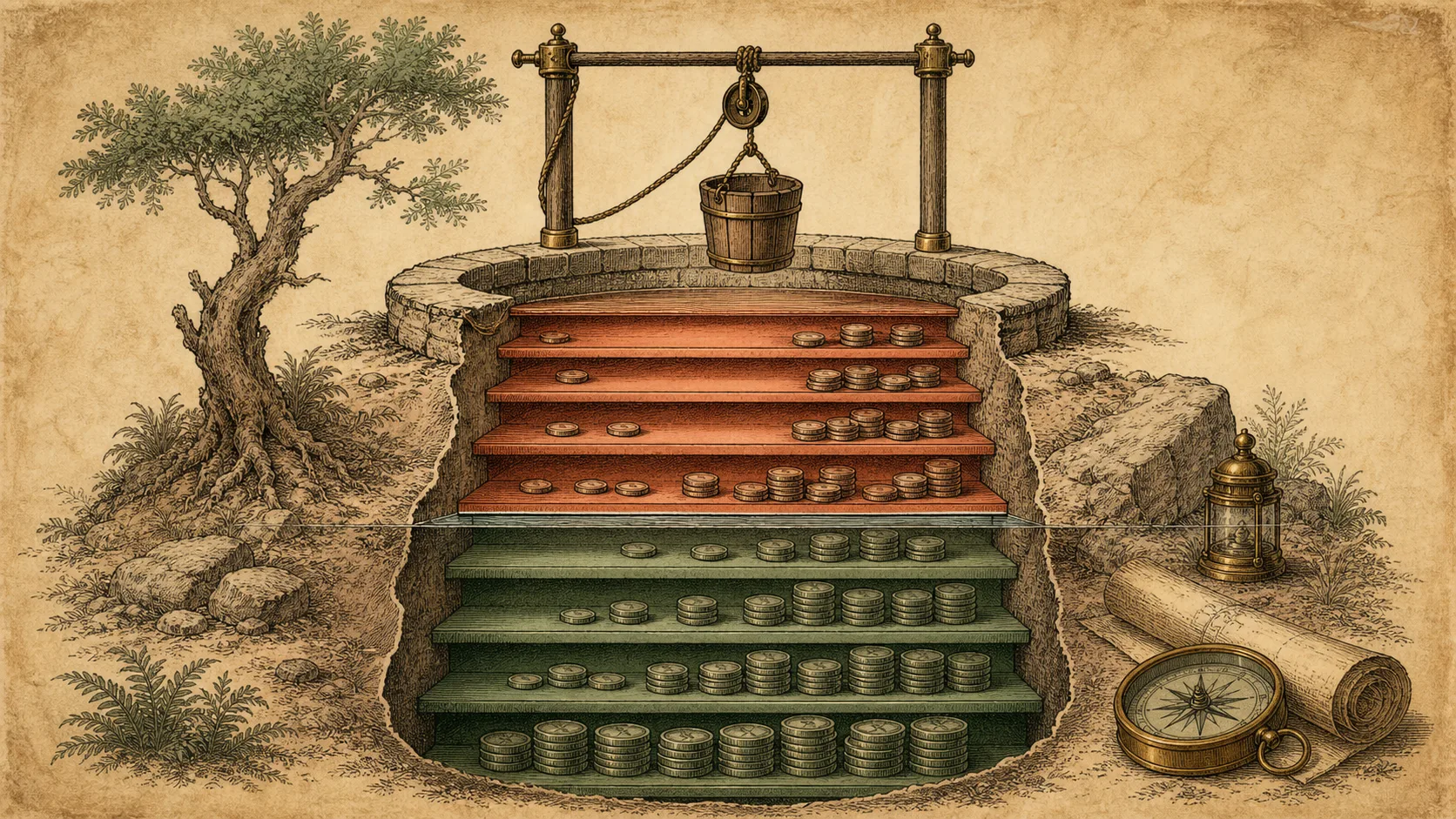
The top quote of a market tells you only two prices: the best bid and the best ask. It says nothing about how much can actually trade there.
Market depth is the amount of size waiting at each price level behind that top quote. It is the difference between a market that absorbs your order quietly and one that jumps 5% when your order arrives.
Market depth is the resting size available at each price level in the order book. It determines how much a given order will move the price. Two markets with the same best bid and ask can have very different depth, which is why the top quote alone never tells you how your order will fill.
What Market Depth Actually Measures
An order book lists buy orders from the highest price down and sell orders from the lowest price up. Market depth is the total size waiting at each of those levels, not just at the top.
Depth matters because it converts a quote into capacity. If the best ask has 100 shares and you want to buy 1,000, your order must trade through the remaining levels above. Each level adds to your average fill price.
The Same Quote Can Hide Completely Different Depth
Two markets can show the identical best bid and best ask: say 99.98 bid and 100.02 ask. One may have thousands of shares behind each level; the other may have a handful.
A market order of the same size will fill cleanly in the first market and sweep several levels, moving the price, in the second. The quote looked the same; the depth did not.
| Level | Bid side (willing to buy) | Ask side (willing to sell) | What it tells you |
|---|---|---|---|
| Top of book | Best bid + size | Best ask + size | Where a small order fills now |
| Next 3–5 levels | Size at each higher bid price | Size at each lower ask price | How far price moves for a medium order |
| Full visible depth | Total size across visible levels | Total size across visible levels | The approximate capacity of the market |
| Level | Size resting | Cumulative buyable |
|---|---|---|
| Ask 1: $10.00 | 1,200 shares | 1,200 shares |
| Ask 2: $10.01 | 1,800 shares | 3,000 shares |
| Ask 3: $10.02 | 2,500 shares | 5,500 shares |
| Ask 4: $10.03 | 3,000 shares | 8,500 shares |
Cumulative size already clears 8,000 shares by Ask 4, so this order fills within four levels without reaching Ask 5.
Of the 8,000 shares, 1,200 fill at $10.00, 1,800 at $10.01, 2,500 at $10.02, and the remaining 2,500 at $10.03 — about $80,143 in total cost. Estimating from the top-of-book $10.00 ask alone would suggest $80,000; the actual bill is about $143 higher, roughly 0.18%. Two stocks can both display '$10.00 / $10.01' at the top and still produce very different numbers here, depending only on how much size is resting behind that quote — which is exactly what the top of book alone cannot tell you.
Depth and Liquidity Are Two Sides of the Same Question
Deep liquidity and deep order books are related but not identical. Depth is the current snapshot; liquidity is the capacity, in practice, to trade size with little impact, which also depends on how fast resting orders are replenished.
In calm conditions, visible depth is a reasonable guide. Around news or panic, resting orders can be pulled or canceled quickly, so a deep book can become shallow within seconds.
Resting orders can be changed or canceled before they trade. Use depth to size your order conservatively, but never assume the levels you see will still be there when your order arrives.
How to Use Depth Before Sizing an Order
Compare your intended order size with the depth near the current price before sending the order. As a conservative rule, keep a single order to a small fraction of the visible top-tier depth so you are not moving the price against yourself.
For heavily traded markets like major ETFs, large depth makes most retail orders trivial. For thin markets, the same order size becomes a price-moving force. Always judge size relative to depth.
Frequently Asked Questions
Is the best bid and ask the same as market depth?
No. The best bid and ask are the top two prices. Market depth is the size waiting across all visible levels behind them.
Does deep visible depth guarantee a good fill?
No. Displayed orders can be withdrawn, especially around news or volatility, so depth can change faster than your order reaches it.
Can I trust depth for thinly traded assets?
Treat it with caution. Thin books have wide levels and can move sharply on moderate orders, and some displayed size may not be real.