
Open your trading app and you will see prices ticking non-stop.
102.31, 102.32, 102.29…
The first reaction is often: Who decides these prices? Why did 102.31 change a second later?
There is no single person sitting behind the market, quietly adjusting prices.
A financial market is more like a huge public quoting floor: someone is willing to buy at one price, and someone else is willing to sell at another. New quotes keep arriving; old quotes keep being withdrawn. When a buyer's and a seller's conditions can match, a trade happens.
Understanding this process is one of the most important first steps in learning to trade.
Only after you see what actually happens in the market will you stop reading every price rise as “everyone is bullish” or imagining every drop as “something is wrong with the market.”
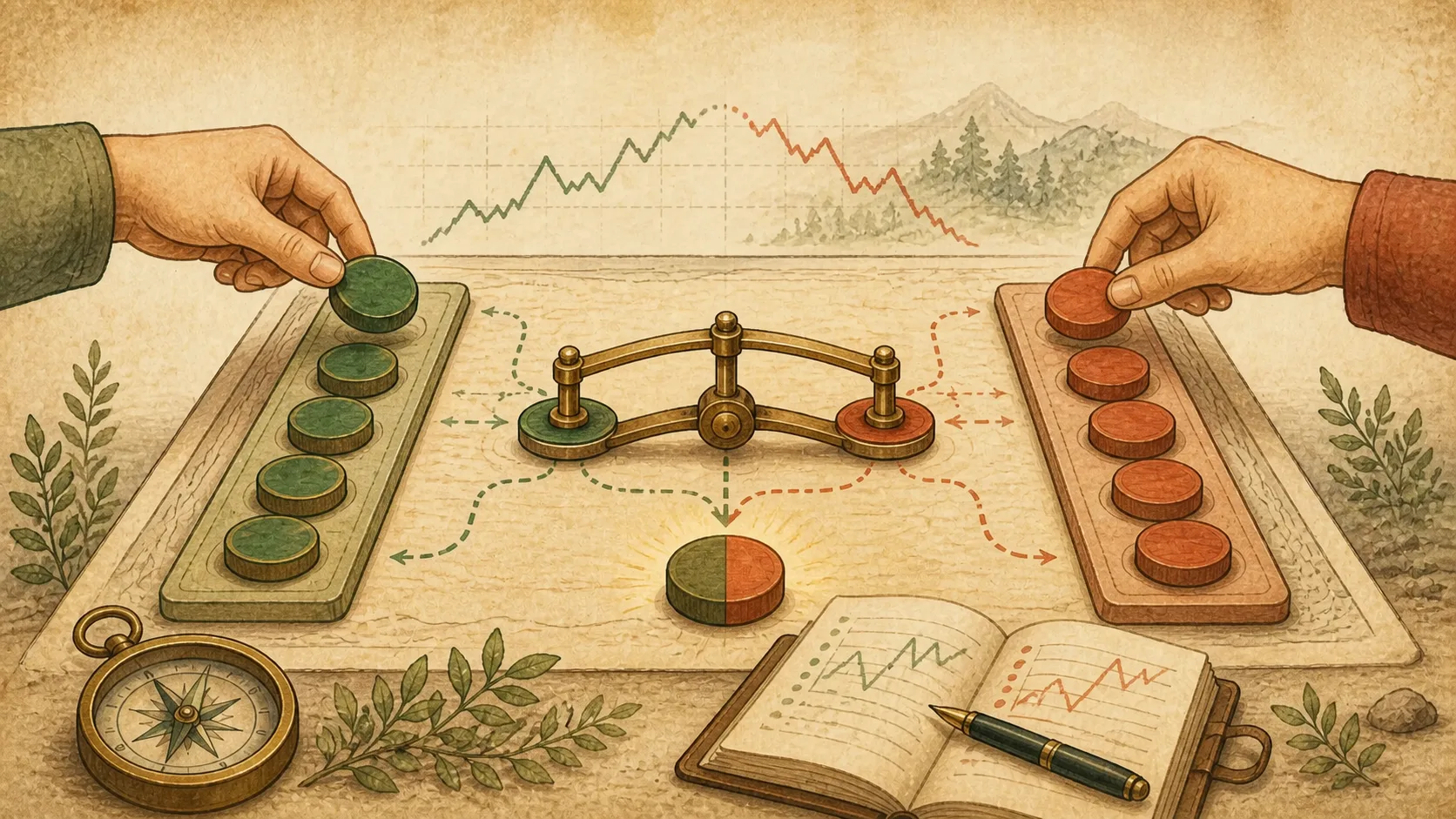
Financial markets match changing buy and sell quotes. Bid and Ask show current willingness, Last records the most recent trade, and Spread shows the gap between buyers and sellers. Prices are not predetermined; they emerge when participants agree to trade.
What Exactly Is a Financial Market?
Let's break down this big-sounding phrase.
Whether it is stocks, forex, gold, or any other tradable asset, every market first has to solve the same problem:
help the people who want to buy find the people who want to sell.
If one person is willing to buy at $100 and another person will only sell for at least $104, the two will not trade right now.
The buyer can keep waiting.
The seller can keep waiting too.
The market will not kindly invent a middle price of $102 and force a trade because the two sides disagree.
A trade happens only when new quotes appear, or participants change their quotes, and the two sides' conditions can finally match.
A market is not a machine that keeps telling you the “correct price.” It is a constantly updating system of quotes and matching. The price you see on screen is the leftover result of countless participants submitting quotes, cancelling orders, and actually trading.
How Does a Trade Happen?
The most ordinary market trade can be broken into four steps.
- 1A buyer submits a quote: the buyer tells the market the highest price they are willing to pay.
- 2A seller submits a quote: the seller tells the market the lowest price they are willing to accept.
- 3Buy and sell conditions match: when the two prices can be matched, the trading system fills the trade.
- 4The fill becomes a new market record: the price and size are recorded, and the most recent completed trade becomes the new Last Price.
At a $100 Bid and $104 Ask, no trade occurs. If a buyer raises their Bid to $104, the quotes match, the trade fills, and $104 becomes the new Last Price.
What Are Bid, Ask, Last, and Spread?
The prices on a trading platform look similar, but they mean completely different things.
Mixing them up is one of the most common beginner mistakes.
| Term | What it represents | How to read it | What it does NOT mean |
|---|---|---|---|
| Bid | The highest price a buyer is currently willing to pay | “How much the most active buyer is willing to pay right now” | Not a price you are guaranteed to get when buying |
| Ask | The lowest price a seller is currently willing to accept | “How much the cheapest seller is asking right now” | Not the last traded price |
| Last | The price of the most recent completed trade | “The price at which someone just traded” | No guarantee the next trade will fill at the same price |
| Spread | The gap between Ask and Bid | “How far apart buyers and sellers are right now” | Not a signal that price must move in a certain direction |
Quote mechanics differ across markets and platforms, but these four concepts are the foundation of reading price information.
When the screen shows “Last price $100,” do not automatically read it as “I can definitely buy at $100 right now.” The last price describes what just happened. The price you can actually trade at depends on the buy and sell quotes and sizes available right now.
So Who Actually Sets the Market Price?
A natural question follows:
If nobody is in charge of pricing, why do prices go up and down?
The reason is not mysterious. Buy and sell willingness in the market is always changing.
Maybe more people suddenly want to buy.
Maybe some sellers withdrew their sell orders.
Maybe someone is willing to pay a higher price.
Maybe more and more holders are willing to lower their asking price.
Every new quote, cancellation, and fill can change the price at which the market can currently trade.
So instead of saying “the market decides the price,” a more accurate way to put it is:
prices are discovered through the constantly changing buy and sell intentions of participants.
A price is not the market's official answer. It is a record left behind after buyers and sellers just agreed on a trade.
MyTrade Academy
Why Do People Buy and Sell Near the Same Price?
This may be one of the most misunderstood things about markets.
Imagine one person buys at $100 while another person sells at $100.
Many beginners immediately conclude:
their views on the future must be opposite, so one of them has to be wrong.
Reality is not that simple. Both people can have perfectly reasonable reasons.
An investor may sell because they need cash; because they reached their target; because they are reducing exposure to a certain asset class; because they want to control risk; or because their investment horizon has ended.
Another investor may buy because their horizon is longer; because they just received new funds; because their risk tolerance is different; or because this asset fits their allocation plan.
The two sides can even have similar views on the market and still complete a buy and a sell in the same moment.
You urgently need a second-hand phone because you have to use it for work tomorrow; the seller urgently wants to sell because they need cash for rent. You want to buy, they want to sell — not because one of you must have wrongly predicted whether the phone will go up or down next week. You simply have different needs, timing, and financial constraints. The participants in financial markets are the same, just on a much larger scale.
Why Can Large Trades Fill at Worse and Worse Prices?
Now let's look one layer deeper into the market.
Suppose the lowest ask is $100.00. If you want to buy just 1 share, you can fill right there.
But here is the real question: how many shares are actually offered for sale at $100.00?
Order books rarely have unlimited size resting at the best price. If your order is bigger than what sits at $100.00, the rest has to fill against the next price levels one after another, until the whole order is filled. Your average fill price ends up higher than the price you first saw on screen — a deviation usually called slippage.
Here is a realistic snapshot of a sell-side order book, and what happens when a market order sweeps through it.
| Level | Price | Shares offered | Cumulative shares available |
|---|---|---|---|
| Ask 1 | $100.00 | 800 shares | 800 shares |
| Ask 2 | $100.05 | 1,200 shares | 2,000 shares |
| Ask 3 | $100.10 | 1,500 shares | 3,500 shares |
| Ask 4 | $100.15 | 2,000 shares | 5,500 shares |
| Ask 5 | $100.20 | 2,500 shares | 8,000 shares |
Tick sizes and lot sizes vary by market; this example uses round numbers purely to keep the arithmetic easy to follow.
A 4,000-share market order eats through four price levels before it is fully filled: 800 shares clear at the best ask of $100.00, but the last 500 shares only find a seller at $100.15. The blended cost works out to about $100.0713 a share — roughly $0.07, or 0.071%, above the $100.00 price first shown on screen. That is a small deviation because this order book is fairly deep. In a thinner market, where only a few hundred shares sit at each level, the same 4,000-share order could sweep a dozen levels and produce much larger slippage.
If a market has a large number of buy and sell orders, even a relatively large trade can find a counterparty quickly without visibly moving the price. This is what we call liquidity. In general, the thinner the market depth and the fewer units available to trade, the more easily a large order crosses multiple prices, and the more noticeable slippage can become.
When Reading the Market, Separate Facts, Interpretation, and Prediction
The real value of understanding market mechanics is not memorizing a few abbreviations.
It changes the way you look at the market.
Suppose you see gold is up 2% today.
That sentence is only a fact. But many people's minds instantly start writing a story: “money must be pouring into gold.” That is an interpretation. Then: “so it should keep rising tomorrow.” That has become a prediction.
There is only one fact, but many different interpretations can surround it, and different interpretations can lead to completely different predictions.
If you mix these three layers together, you can easily mistake your own guesses for something the market has already proven.
- 1Fact: what did I actually see? For example: price rose from 100 to 103, and volume increased.
- 2Interpretation: why do I think it happened? For example: more active buying may have appeared.
- 3Prediction: if my interpretation is right, what should happen next? For example: price may stay strong.
- 4Counterexample: what would show my interpretation is probably wrong? For example: price quickly falls back into its previous range with fresh selling.
Do not write “the market is strong, it will definitely keep rising.” Try instead: “Fact: price broke yesterday's high. Interpretation: buyers are currently more aggressive. Prediction: if this continues, price may keep moving higher. Counterexample: if price quickly falls back below the breakout, I need to re-examine this interpretation.” You are not training yourself to predict with more confidence; you are training yourself to know what is evidence and what is only your judgment.
What Is the Real Difference Between Trading and Gambling?
Markets certainly involve uncertainty. You can buy wrong, and you can lose money.
So saying “trading can make or lose money” does not prove trading is gambling.
What actually matters: do you know why you acted? Is there a basis you can check? When you are wrong, do you have an explicit exit condition? Do you limit how much one mistake can cost? Can you re-examine your original judgment afterwards?
If someone keeps betting simply because they “feel it is about to go up,” even inside a regulated financial market, that behavior can still be very close to gambling.
By contrast, accepting uncertainty, building rules, limiting risk, and continuously testing your judgments is closer to a repeatable trading process you can learn from and improve.
The market itself is neither a casino nor an ATM.
What really defines the nature of the behavior is how you use the market.
Being professional does not mean being certain you are right. It means having a set of rules you can execute and check even when you do not know the answer.
MyTrade Academy
What Should You Learn After Understanding Market Mechanics?
At this point, you do not need to start predicting which market will rise tomorrow.
More importantly, you have built your first map of the market:
Buyers and sellers submit quotes;
Bid and Ask describe the two closest sides of a potential trade;
A trade happens when conditions match;
Last is a record of a trade that already happened;
Spread is the distance between the current buy and sell quotes;
Liquidity and order depth affect how your order actually fills;
Behind every buy and sell there can be completely different motives;
When observing the market, separate facts from your own interpretation.
The next, more important question becomes:
Since the future is never certain, how much risk should I take?
That is the problem MyTrade Academy's next lesson addresses.
Frequently Asked Questions
Who decides the price in a financial market?
Usually no single person or institution keeps assigning one “correct price” to the whole market. Market prices come from buy and sell quotes that participants continuously submit and change, plus the trades that actually fill. Specific trading mechanics differ across markets, but the core of price formation is still about buy/sell intentions and execution.
What is the difference between Bid and Ask?
Bid is the highest quote a current buyer is willing to pay; Ask is the lowest quote a current seller is willing to accept. Ask is usually above Bid, and the distance between them is the Spread.
Why is the last price different from the price I actually get?
Because Last Price only represents the most recent completed trade. By the time your order is submitted, the quotes and available sizes may already have changed. If your order is large, it may also fill at several different prices.
Why can buyers and sellers exist in the market at the same time?
Because participants have different goals, funding needs, time horizons, risk tolerance, and positions. One side buying while the other sells does not mean one of them must be wrong.
Is trading gambling?
Both involve uncertainty, but “win or lose” is not the most important difference. What separates disciplined trading from plain betting is whether you have checkable evidence, explicit risk boundaries, a repeatable process, and a post-trade review.