
A trading screen can show Bid, Ask, Last, and Spread at the same time. Beginners often treat them as several versions of the same “current price.” They are not.
Then comes slippage: you click Buy at one price and your actual average fill is slightly worse. None of this is decorative market jargon. These numbers describe what you can actually trade and what execution may cost.
Bid is the highest current buying quote, Ask is the lowest current selling quote, Last is the most recent completed trade, and Spread is Ask minus Bid. Slippage is the difference between the price you expected and the price at which your order actually fills.
| Term | Meaning | What it tells you | Common mistake |
|---|---|---|---|
| Bid | Highest current buy quote | What the most competitive buyer is offering | Assuming this is the price to buy immediately |
| Ask | Lowest current sell quote | What the cheapest seller currently wants | Confusing it with the last traded price |
| Last | Most recent completed trade | Where someone just traded | Assuming your next order must fill there |
| Spread | Ask minus Bid | The gap between the best current quotes | Ignoring it as a transaction friction |
Why the Spread Is a Real Cost
Suppose Bid is $99.90 and Ask is $100.00. If you buy immediately, you may pay $100.00. If the market does not move and you immediately sell, you may receive only $99.90.
You were not wrong about market direction. You simply crossed a $0.10 spread. That gap is part of the friction of demanding immediate execution.
What Is Slippage?
Spread describes the gap in visible quotes. Slippage describes what happens during execution.
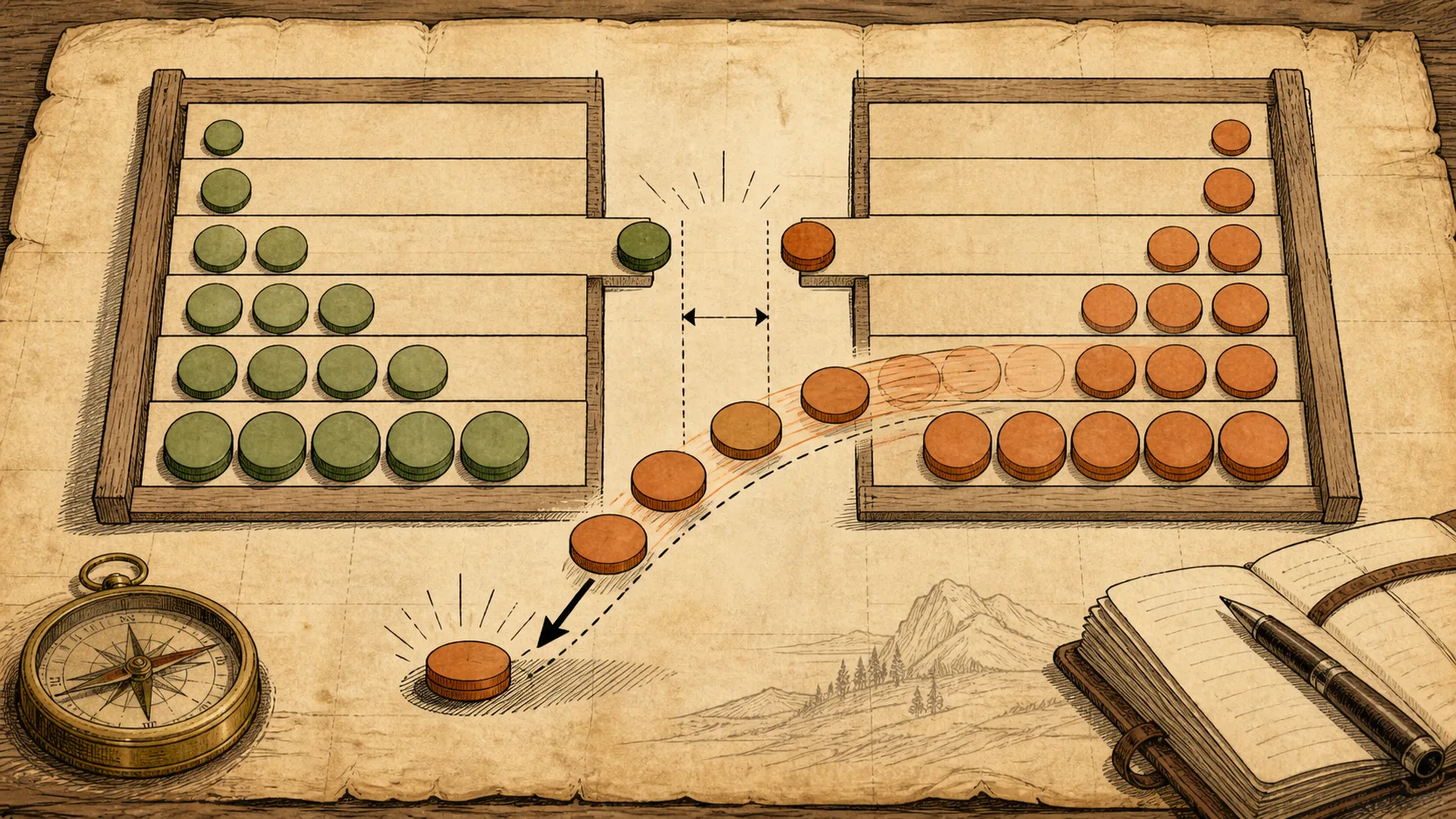
Imagine you see an Ask of $100 and send a market order for 5,000 shares. If only 500 shares are offered at $100, the rest may fill at $100.05, $100.10, or $100.20. Your average price might become $100.12.
The difference between the price you expected and the actual average fill is slippage. It tends to matter more when orders are large, markets are thin, or prices are moving quickly.
Here is the order book behind that example, worked out level by level.
| Level | Shares available | Cumulative shares available |
|---|---|---|
| Ask at $100.00 | 500 shares | 500 shares |
| Ask at $100.05 | 1,000 shares | 1,500 shares |
| Ask at $100.10 | 1,500 shares | 3,000 shares |
| Ask at $100.20 | 2,000 shares | 5,000 shares |
These figures are illustrative only, chosen to make the weighted-average arithmetic easy to check.
The 5,000-share market order first clears the 500 shares resting at $100.00, then 1,000 shares at $100.05, then 1,500 shares at $100.10, leaving the final 2,000 shares to fill at $100.20. The weighted-average fill price comes out to $100.12 — $0.12 more than the $100.00 Ask first shown on screen. That is the actual slippage this order experienced. With thinner depth at each level, the same 5,000-share order could sweep even more price levels and produce noticeably larger slippage.
Spread exists between the best Bid and Ask before you trade. Slippage appears when your actual execution differs from the price you expected. Both can hurt results, but they come from different parts of the trading process.
Why Do Spreads and Slippage Get Worse During Volatility?
Around major news, market opens, sudden company announcements, or periods of low liquidity, participants may cancel quotes or demand more compensation for taking risk.
That can widen the gap between Bid and Ask and reduce the number of shares available at each price. The result is simple: immediate execution becomes more expensive just when people are most tempted to trade quickly.
| Cost | Where it comes from | Fixed? |
|---|---|---|
| Spread | Gap between best buy and sell quotes | No |
| Slippage | Order depth and price movement during execution | No |
| Commission | Broker or venue fee schedule | Depends on pricing model |
| Taxes / product fees | Market and product rules | Depends on market and instrument |
- 1Check Bid, Ask, and available size instead of staring only at Last.
- 2Avoid sending an order much larger than the visible depth without understanding the execution risk.
- 3During fast markets, notice whether the spread has widened before demanding immediate execution.
- 4When reviewing a strategy, include commissions, spread, and actual slippage rather than testing on fantasy fills.
Frequently Asked Questions
Why does my position show a small loss immediately after I buy?
One common reason is that you bought near the Ask while the position may be marked closer to the Bid. The spread, plus any commission or fees, can create an immediate small loss even if the market has not moved.
Can a limit order eliminate slippage?
A limit order can control the worst price you are willing to accept, but it creates another risk: the order may fill only partially or not at all. Execution quality always involves trade-offs.
Is the smallest spread always the best market?
A tight spread is useful, but it is only one factor. Market depth, commissions, execution quality, volatility, and product risk also matter.