
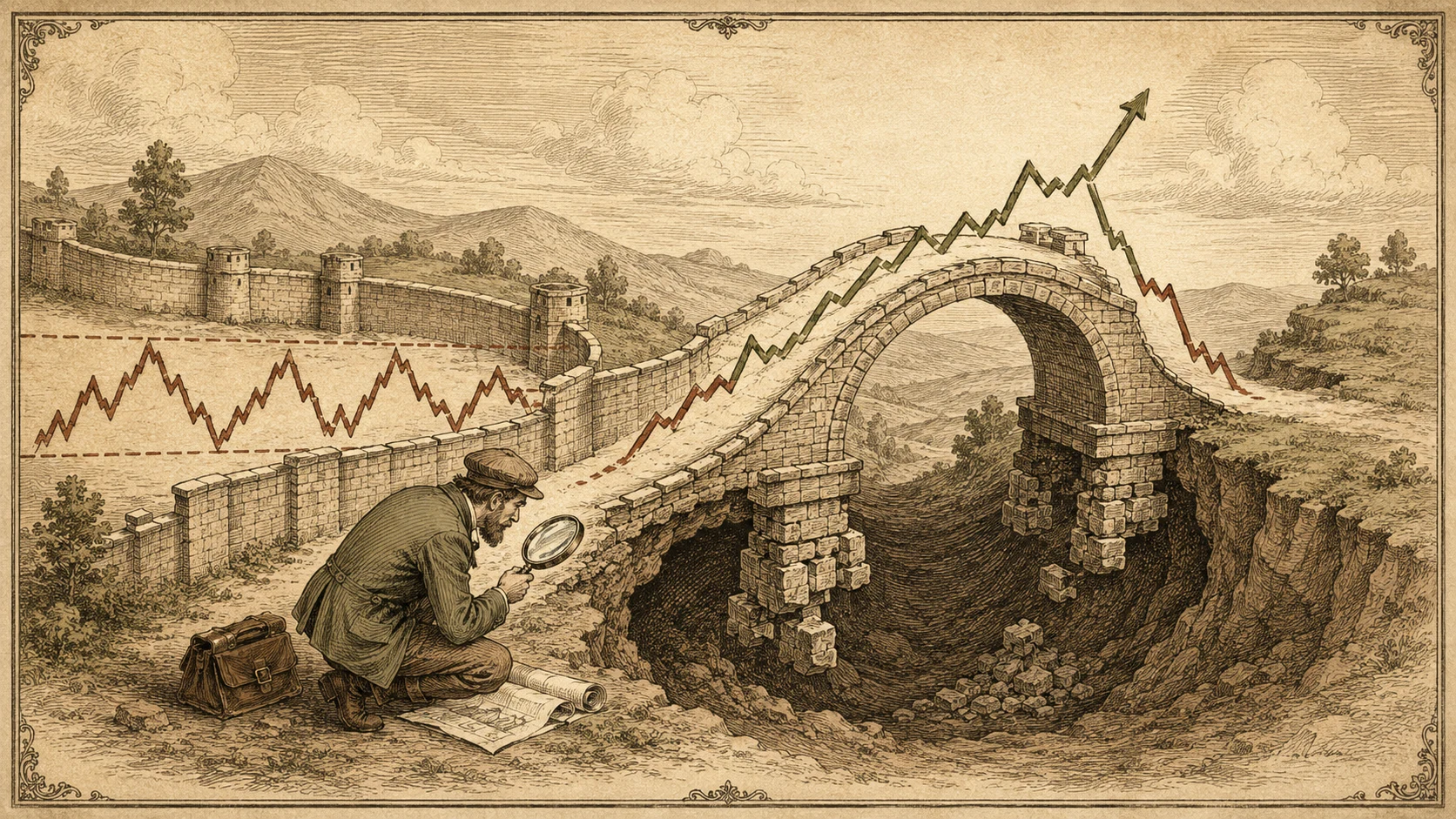
Trading classic chart breakouts—buying new highs or shorting breakdowns—is one of the first strategies taught to novice traders.
It seems completely logical: buy when price demonstrates strength by piercing resistance. Yet in real trading, many market participants discover that the majority of breakouts they enter end up stalling, reversing, and hitting stop-losses.
Why do breakouts fail so frequently? A failed breakout is rarely random; it occurs when market microstructure lacks the secondary demand necessary to sustain the move.
Breakouts fail primarily due to five structural factors: lack of secondary follow-through volume, trading in illiquid market sessions, crowded textbook technical levels, news-driven knee-jerk spikes, and immediate range reclaims. Recognizing these failure modes allows traders to filter low-probability setups and enforce disciplined invalidation before losses mount.
| Failure Mode | Microstructural Mechanism | Recommended Solution |
|---|---|---|
| Weak Follow-Through | Initial stop-run exhausts momentum; zero fresh buyers enter at higher prices | Wait for confirmation candles or enter on the first pullback retest |
| Illiquid Session Chasing | Shallow order books allow small orders to create artificial level breaches | Restrict breakout entries to major session opens (London/NY overlap) |
| Overly Crowded Levels | Obvious textbook lines act as primary liquidity targets for institutional exits | Avoid obvious double tops; look for tighter pre-breakout consolidation |
| News Spike Reversals | Macro headlines cause high-frequency algorithmic whipsaws without structural backing | Avoid trading breakouts within 15 minutes of major economic releases |
| Immediate Range Re-entry | Price fails to find acceptance outside the boundary and is sucked back inside | Enforce immediate stop-loss rule the moment candle closes back inside range |
Deconstructing the Anatomy of Breakout Failures
Failure Mode 1: Lack of Secondary Follow-Through. The initial burst of a breakout often triggers resting orders around the boundary. But for a breakout to transform into a multi-day trend, it requires 'secondary participation'—fresh buyers willing to bid at progressively higher prices. If that second wave fails to appear, even minor profit-taking rolls price back inside.
Failure Mode 2: Illiquid Sessions. Breakouts during the late Asian session for EUR/USD or pre-market for equities often reflect shallow order book depth rather than broad market participation. When the primary session opens and regular liquidity arrives, price often reverts back into the range if broader market participants do not agree with the new price.
Failure Mode 3: The Crowded Level. When a chart level is widely watched and crowded, thousands of traders place identical breakout entries and resting stop-loss orders in the same tight cluster. Once price crosses the level and triggers this liquidity pool, if persistent incoming demand fails to materialize, the pool quickly empties and trapped longs selling into a thin book can trigger an aggressive snapback.
Breakouts that occur after a vertical sprint frequently face momentum exhaustion. They occur after tight, quiet, volatility-contracted consolidations (such as a multi-week cup-and-handle or tight bull flag) where price coils directly against resistance before exploding.
Frequently Asked Questions
Does breakout trading have an inherently lower win rate than mean-reversion?
Yes. Pure breakout trading typically has a win rate between 35% and 45%. Its profitability relies on achieving large reward-to-risk ratios on successful trends while cutting failed breakouts quickly with minimal loss.
Can a failed breakout become a valid trading opportunity?
Yes! A failed breakout is one of the most powerful reversal signals in technical analysis. Trading against trapped breakout participants often produces rapid, directional moves toward the opposite end of the range.
What is the single biggest mistake traders make when a breakout fails?
Refusing to accept failure and turning a momentum trade into an unintended long-term holding position as price plummets back through the range.