

Our call
This week’s expected range · USD/oz
Downside riskMore hikes remain
Upside potentialFed signals a pause
Key eventFed decision · Sep 16
Gold mechanism map
What is driving gold this week?
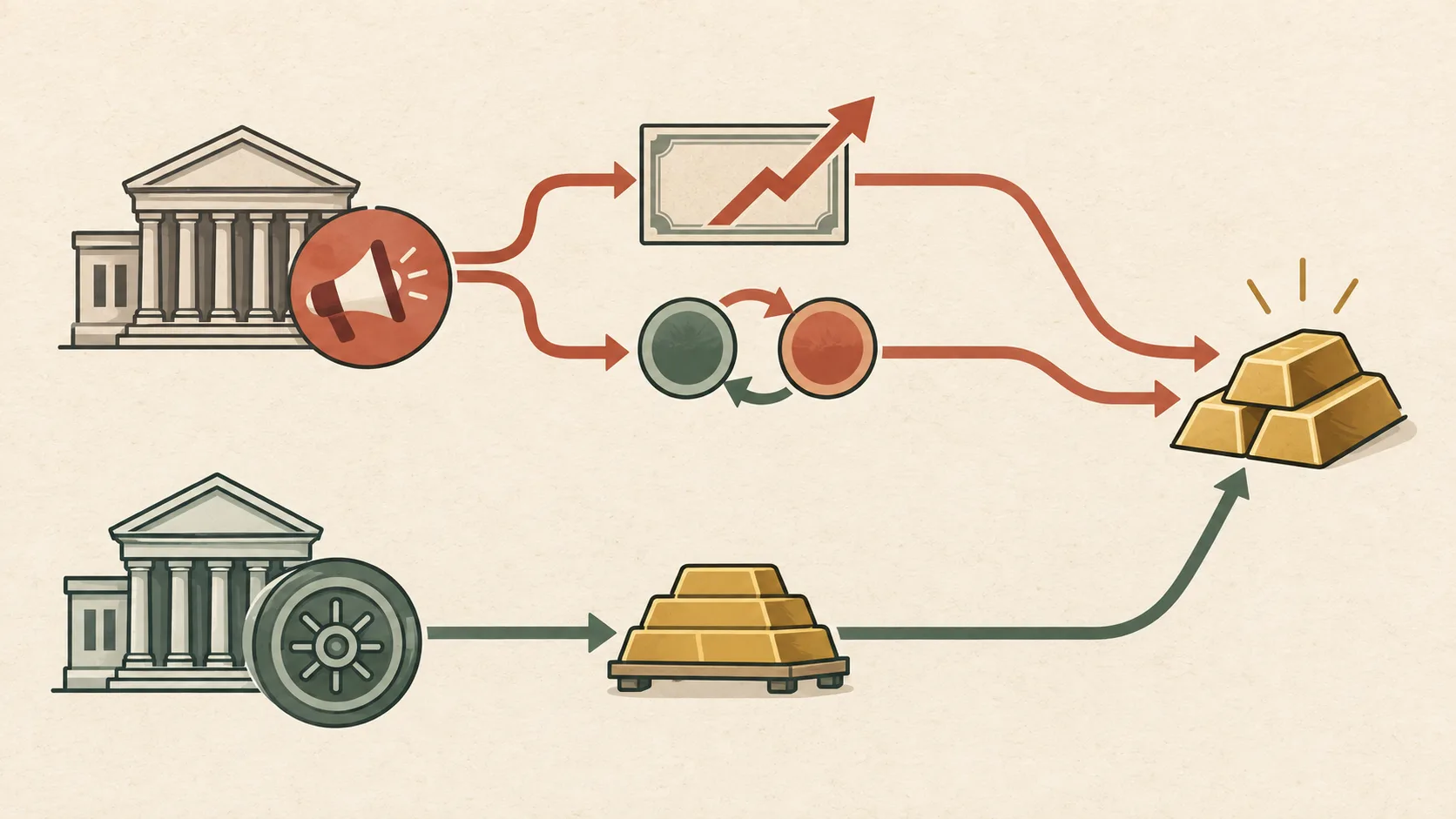
Long-term buyers support gold. The next trade still sets the price.
Structural support
- Central banks750–1,000t/yr
- PBoC+20t in August
- US debt>$40tn
Short-term pressure
- 10Y Treasury>5.04%
- Fed hike odds~90%
- DXY~99.6
Central banks and short-term investors are answering different questions. Reserve managers seek long-term diversification and protection through financial uncertainty, while funds ahead of the Fed meeting compare gold with bonds and cash. That is why central-bank buying can continue even when higher Treasury yields and a stronger US dollar push gold lower.
Structural support is a continuing source of demand, not a guaranteed minimum price. Much of that demand is already part of the market's background; a surprise in the rate outlook gives investors new information to act on. Our view is that this faster repricing is the stronger force this week.
Fed-to-gold decision tree
The next move matters more than this hike
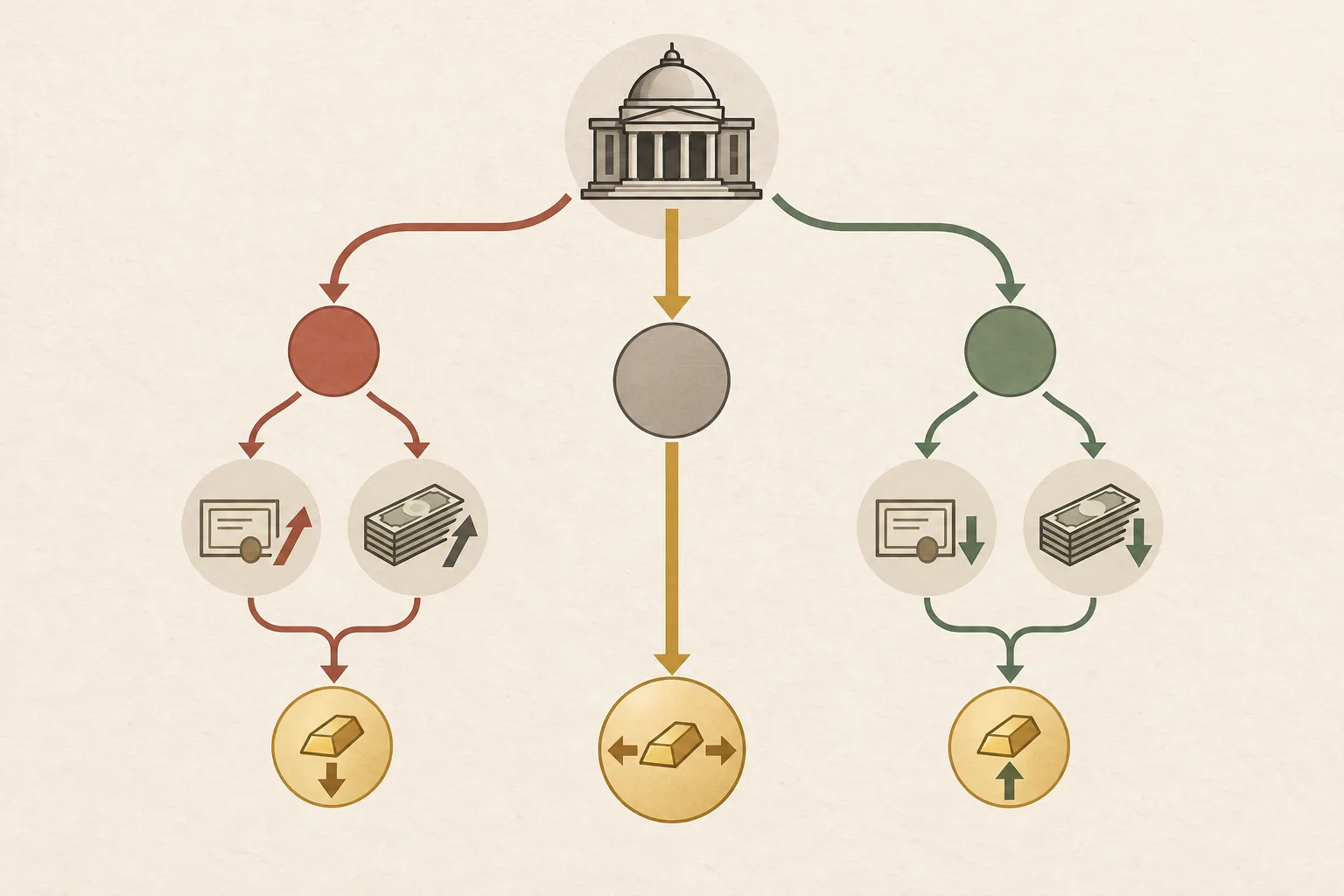
Gold reacts to the surprise, not just the rate decision.
More hawkish
- Dot plotMore hikes
- Yields↑
- Dollar↑
Base case · Fed reaction
- 25bp hike~90% priced
- GuidanceBalanced
- GoldRange-bound
Pause signal
- Yields↓
- Dollar↓
- Gold↑
Priced in means investors have already adjusted their positions for an expected outcome. Markets have largely prepared for this hike, so the more important variable for gold is the future policy path signalled by the Fed. Longer-term borrowing rates can move even when the immediate decision is unsurprising.
Imagine investors prepare for this hike and two more later. If the Fed delivers the hike but signals that further increases are less likely, the expected path moves down: bond yields can fall and gold can rebound. The dot plot shows policymakers' rate projections, while the press conference explains what could change them.
The follow-through matters after the first reaction. A gold bounce accompanied by lower yields and a softer dollar supports our upside scenario; a bounce that fades while both recover leaves our cautious view intact. The message and the market response need to tell the same story.
Learning mechanism
Why higher yields hurt gold
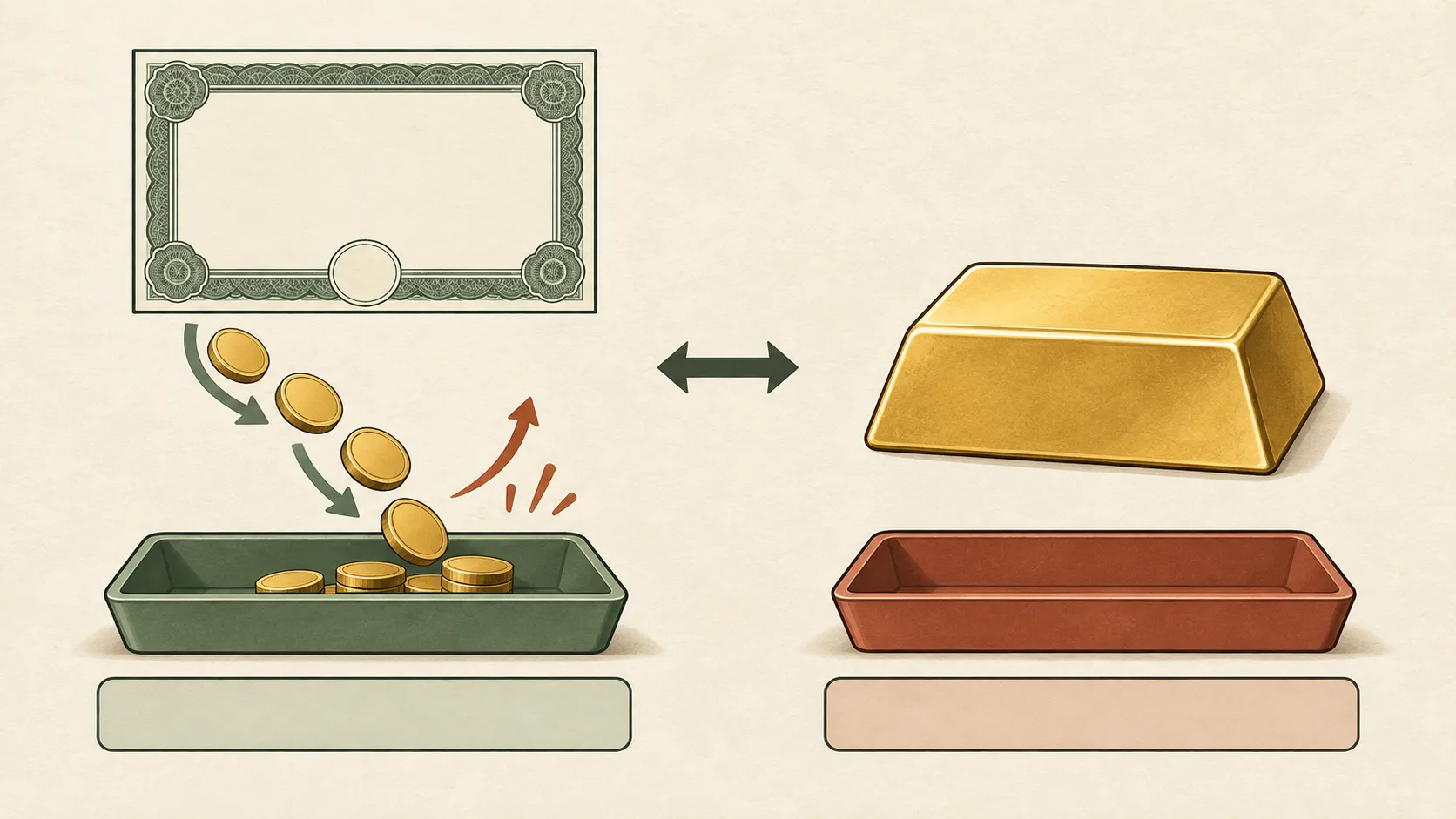
The cost of holding gold includes the income you give up elsewhere.
A gold bar does not make regular interest payments. Its appeal rests on what it can be sold for later and the protection it offers within a portfolio. When competing investments offer more income, a buyer needs a stronger reason to choose gold instead. That forgone income is its opportunity cost.
For a simple hypothetical comparison, $10,000 earning 3% for one year produces $300 before costs and tax; at 5%, it produces $500. The extra $200 raises the opportunity cost of holding gold. A fixed-rate bond's coupon does not change when yields rise; a lower purchase price raises the yield available to a new buyer. Real yields also account for inflation expectations.
The dollar works through a second channel. A stronger US dollar makes the same dollar-priced gold bar cost more for a buyer paying in another currency, which can discourage fresh demand. For our weekly view, stronger income competition and a firmer dollar reinforce each other.
| Hypothetical principal | Annual yield | Interest after one year |
|---|---|---|
| $10,000 | 3% | $300 |
| $10,000 | 5% | $500 |
Dollar channel
- Stronger dollar
- Higher local-currency cost
- Pressure on demand
Our base case
Our weekly call remains range-bound with a downside bias at $4,200–$4,500. We expect rates and the dollar to make sustained gains difficult, while continuing demand gives buyers a reason to respond to declines. This is MyTrade Academy's editorial forecast, not an institutional consensus or an observed trading range.
Our base case after the Fed is a 25bp hike with balanced guidance, represented by the narrower $4,250–$4,400 reaction range in the decision graphic. The wider weekly range allows for movement around the meeting. Its edges are checkpoints: a sustained break backed by a changed rate or dollar outlook would require a new forecast.
What changes the view
The bigger picture
Why would central banks accept an asset that pays no interest? Their job is broader than maximizing this year's income. The World Gold Council's 2026 survey identifies crisis performance, long-term value and diversification as key reasons for holding gold. A reserve portfolio spread across different assets depends less on any single currency or source of returns.
That longer-term demand can remain relevant after this week's policy shock, but it does not predict Friday's close. Our $4,200–$4,700 Q4 editorial range is separate from the weekly forecast. The institutional comparisons below also use different horizons: a quarterly average smooths prices across the quarter, while a year-end target describes one point in time.
Institution forecast
How the longer-term views compare
Compare the assumptions as well as the numbers. Quarterly forecasts, year-end estimates and our Q4 range are different measures; they are not a single weekly consensus.
- LBMA SurveyWide range; year-end average ~$4,500
- J.P. MorganQ4 target $4,500
- ING ResearchQ4 target $4,600
- MyTrade AcademyQ4 base range $4,200–$4,700
See the detailed institutional views
| Institution | Near-term target | Longer-term | Core view |
|---|---|---|---|
| J.P. Morgan | Q3: $4,300 / Q4: $4,500 | 2027: $4,775 | Cautious now; bullish if Fed pivots |
| UBS CIO | Use weakness to buy | — | Structural bull; gold = portfolio hedge |
| ING Research | Q3: $4,300 / Q4: $4,600 | — | Higher-for-longer rates = near-term drag |
| LBMA Survey | Year-end avg: ~$4,500 | — | Wide range: $3,879 – $5,100 |
This week · ET
Retail sales arrive before the Fed decision; Thursday's jobless claims provide the next employment check. All times are Eastern Time.
Retail sales
8:30 AM · Does consumer spending reinforce or soften the pre-meeting outlook?Fed decision
2:00 PM · Watch the guidance on further hikes.Press conference
2:30 PM · Listen for the message on the next move.
Jobless claims
8:30 AM · Does the employment signal support the Fed's message?
Next major eventWed Oct 14 · US CPI (Sep)The next major catalyst for the Fed outlook
Sources
- ReutersFed rate hike on Wednesday now likely, say economists
- Federal ReserveSeptember 2026 FOMC calendar
- J.P. Morgan Global ResearchGold Price Predictions for 2026 and 2027
- UBS CIOLook beyond rates to gold’s long-term support
- ING ResearchGold’s correction prompts a forecast reset
See 7 more sources
- World Gold CouncilPaved with good interventions
- LBMA2026 Analysts’ Forecasts
- Federal ReserveMonetary Policy: What Are Its Goals? How Does It Work?
- Federal ReserveJune 2026 Summary of Economic Projections: how to read the dot plot
- TreasuryDirectUnderstanding Pricing and Interest Rates
- World Gold CouncilCentral Bank Gold Reserves Survey 2026: strategic considerations
- U.S. Census BureauEconomic Indicator Release Schedule: retail sales
Further reading
Learn the concepts behind this story
This forecast connects monetary policy, Treasury yields, the US dollar and central-bank gold buying. These Academy resources explain the relationships behind the week’s market reaction.