
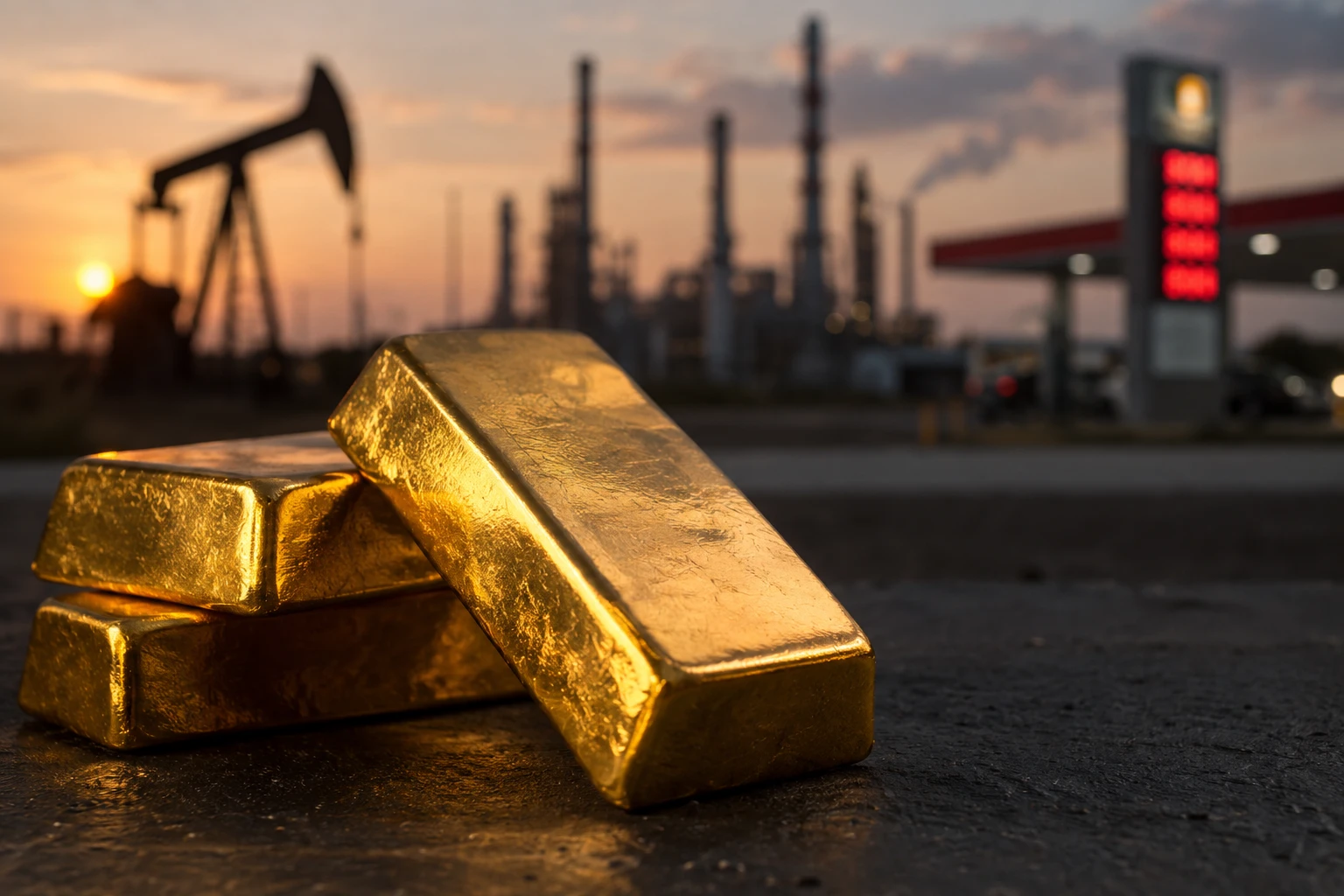
Gold fell to its lowest level in more than a month on Monday as rising oil prices and firmer US inflation revived expectations that the Federal Reserve will raise interest rates this week.
Spot gold was down 0.8% at $4,312.59 an ounce, while US gold futures fell 1.3% to $4,351.90.
Pressure on bullion came from several directions at once. Higher energy prices have renewed inflation concerns, the US dollar strengthened, and the benchmark 10-year Treasury yield briefly moved above 5% for the first time since October 2023.
Why inflation is back in focus
US consumer prices rose 0.4% in August from the previous month and 3.4% from a year earlier, according to the Bureau of Labor Statistics. Gasoline prices increased 3.9% during the month and the broader energy index rose 2.1%.
Those numbers matter to markets because investors are trying to judge whether higher energy costs will keep inflation strong enough to require tighter monetary policy.
The latest move in oil has added another layer to that debate. When investors expect inflation to remain persistent, they can also raise their expectations for interest rates and bond yields. That chain of repricing has been an important source of pressure on gold.
The market is therefore responding to a sequence rather than to one number in isolation: energy prices can affect inflation expectations, those expectations can change the outlook for rates, and the rate outlook can reshape the relative appeal of gold.
Market snapshot
The signals investors were repricing
$4,312.59
Spot gold
-0.8%
5.01%
10-year Treasury yield touched
+0.4%
August US CPI, month on month
3.4%
August US CPI, year on year
Data view
How the pressure travelled through markets
The figures below are the data points referenced in this report, not a price forecast.
| Signal | Reading | Why it mattered |
|---|---|---|
| Gasoline | +3.9% in August | The largest energy component cited in the CPI release added to the inflation debate. |
| Energy index | +2.1% in August | A broader measure showing that the move was not limited to one retail fuel price. |
| Headline CPI | +0.4% month on month | A reading investors weighed against the prospect of tighter policy. |
| 10-year Treasury yield | Briefly above 5% | Higher bond yields raised the opportunity cost of holding a non-yielding asset. |
Why higher yields can hurt gold
Gold does not pay interest. That means its relative appeal can weaken when government bonds offer investors a higher yield.
A rise in Treasury yields therefore increases the opportunity cost of holding bullion. If higher US yields also support the dollar, the pressure can become stronger because gold is priced globally in dollars.
The relationship is not mechanical. Gold can still benefit from geopolitical stress, central-bank buying or concerns about long-term fiscal stability. But in Monday’s session, the shorter-term interest-rate channel dominated.
That distinction is useful for reading market moves. A gold price can be reacting to inflation and still fall if investors decide that the likely policy response will make cash and government bonds more attractive in the near term.
“Inflation matters for gold only after you ask what it is doing to rates, yields and the dollar.”
Why it matters
This move is a useful example of why market relationships are rarely one-dimensional.
Inflation is sometimes described as “good for gold”, but that is only one possible channel. If higher inflation also pushes interest rates, bond yields and the dollar higher, those forces can weigh on gold in the short term.
Instead of asking whether inflation is simply bullish or bearish for gold, ask which transmission channel the market is pricing most aggressively today.
The Federal Reserve is the next catalyst
The Federal Open Market Committee meets on September 15–16. The policy decision is scheduled for 2:00 p.m. ET on Wednesday, followed by the Fed chair’s press conference at 2:30 p.m.
A Reuters poll published on Monday found that 85% of economists expected the Fed to raise its target rate by 25 basis points to 3.75%–4.00%.
For gold, the decision itself is only part of the story. Investors will also be watching how the Fed describes inflation, whether policymakers signal further tightening, and how Treasury yields and the dollar react after the announcement.
What to watch next
Sources
- ReutersGold falls to over one-month low as oil rally, inflation data boost rate-hike bets
- U.S. Bureau of Labor StatisticsConsumer Price Index, August 2026
- ReutersUS 10-year yields reach 5%, highest since 2023
- Reuters PollFed rate hike on Wednesday now likely, say economists
- Federal ReserveSeptember 2026 FOMC calendar
Further reading
Learn the concepts behind this story
This story connects inflation, interest rates, bond yields and gold. Use these Academy resources to understand the mechanics behind the move.