
Before risking hard-earned capital, every disciplined trader wants to verify their system. But when beginners ask whether they should backtest or paper trade, they often treat the two as competing alternatives: 'Should I test history, or should I just trade a demo account?'
They are not competitors; they test completely different parts of the trading equation. One tests the mathematical logic of the rules; the other tests your human ability to execute those rules in real time.
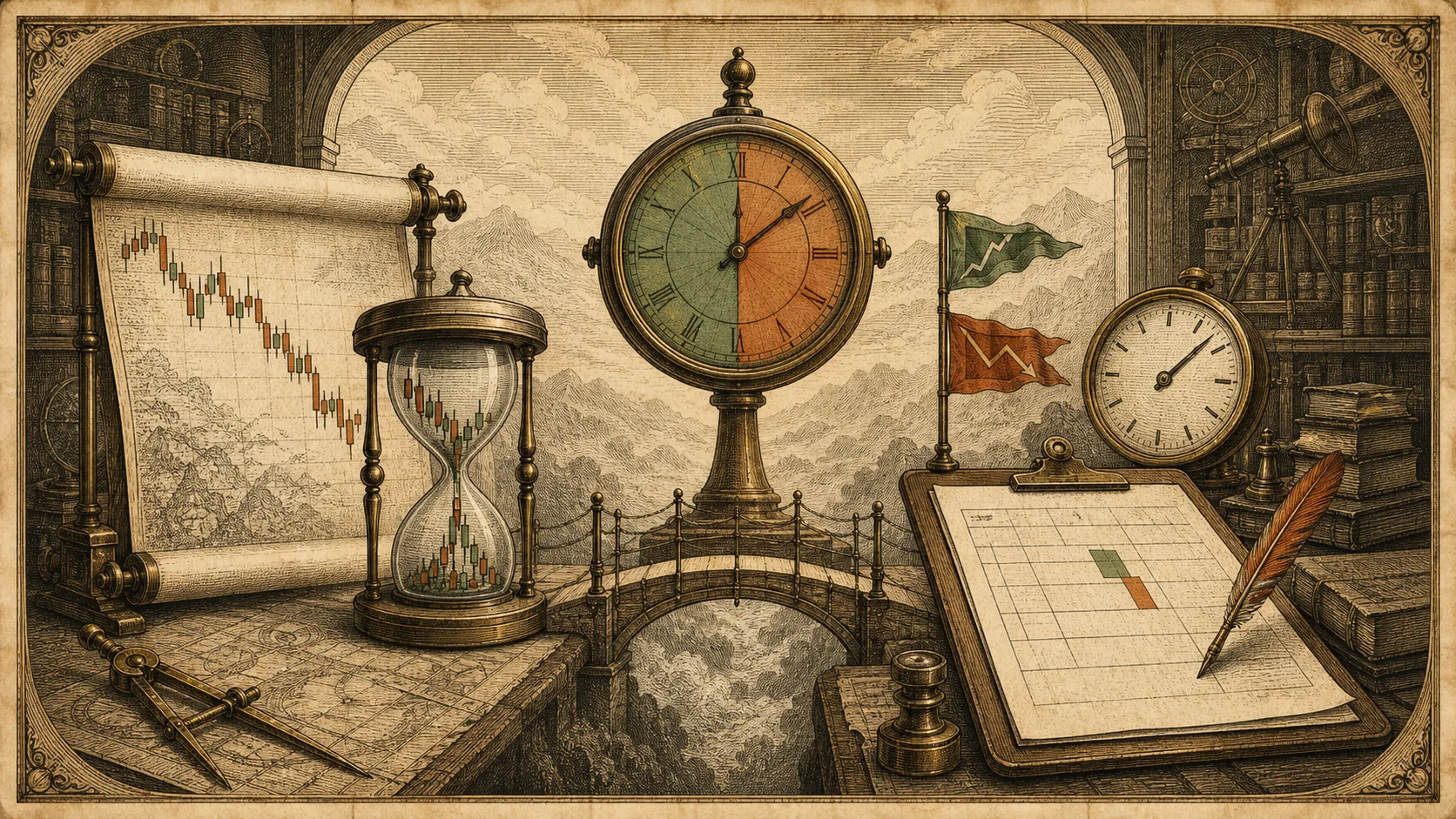
Backtesting applies trading rules backward against historical price data—delivering high sample sizes in hours, but lacking real-time psychological pressure and true execution friction. Paper trading (forward demo trading) executes simulated orders against live incoming market data—testing your operational reflexes, software proficiency, and discipline on the live clock, but taking weeks or months to accumulate statistical significance. Backtesting proves your *strategy*; paper trading rehearses your *execution*. Use both in sequence before risking real capital.
The Core Difference: Direction in Time
The most fundamental difference between the two methods is the arrow of time.
In backtesting, the future is already written. You scroll historical candlestick charts backward, bar by bar, to determine how your entry and exit rules would have performed across past market regimes. Its primary superpower is speed and sample size: in a single weekend, you can manually audit 100 setups across three years of market history.
In paper trading, time moves strictly forward at exactly one second per second. You sit at your trading desk during live market hours, observing real-time price quotes and sending simulated orders with zero financial risk. Its primary superpower is live operational rehearsal: you discover whether you can actually spot the setup before it moves, manage order types quickly, and sit patiently through quiet hours without taking random boredom trades.
| Dimension | Backtesting (Historical) | Paper Trading (Forward Demo) |
|---|---|---|
| Time Direction | Backward (Testing completed historical data) | Forward (Simulating on live, unformed ticks) |
| Sample Generation Speed | Fast (50-100 trades evaluated in days) | Slow (Takes weeks or months to reach 50 trades) |
| Execution Friction | Abstract / Estimated (Assumes fills at planned prices) | Realistic (Tests live platform latency, bid-ask spreads, order routing) |
| Psychological Realism | Zero (No live waiting, no ticker stress) | Moderate (Experience live uncertainty, though no real capital at stake) |
| Primary Blind Spot | Hindsight bias & curve-fitting rules to fit past charts | Small sample sizes & taking careless gambles due to 'fake money' mindset |
A strategy that fails in backtesting is dead on arrival. But a strategy that succeeds in backtesting will still fail live if you cannot execute it in paper trading.
Why Relying on Only One Sets You Up to Fail
The 'Backtest-Only' Trap: You spend weeks backtesting a trend-following system and discover an incredible +3.2 Profit Factor. Excited, you fund a live account on Monday. Suddenly, live reality hits: you must sit in front of the screen for four hours waiting for a trigger; when the trigger fires, price spikes so fast your fill is slipped; and when the position goes 1R into the red, your stomach churns and you panic-close. Backtesting verified the chart pattern, but it never prepared you for the clock or your emotions.
The 'Paper-Only' Trap: You start paper trading a discretionary breakout strategy with no historical backing. You take seven trades over two weeks, win five of them, and assume you have discovered a money machine. In reality, the overall market happened to be in a raging, highly forgiving bull momentum phase. The moment the market enters a choppy range, your system gets shredded because you never tested how it survives hostile historical regimes.
1. Backtest (Proof of Concept): Test 50+ trades across diverse historical market phases to verify that the rules possess a genuine statistical edge.
2. Paper Trade (Execution Rehearsal): Trade the rules live on a demo account for 20-30 trades to master software execution and rule adherence without financial risk.
3. Micro-Live (Emotional Calibration): Transition to real capital using minimum possible sizing (e.g., 1 micro contract or 5 shares) to experience true financial risk without catastrophic stakes.
- I have backtested at least 50 historical trades across trending and choppy regimes.
- My backtest deductions include realistic broker commissions and bid-ask spreads.
- I have paper-traded for at least 20 live setups without violating system rules.
- I treat paper trading demo funds with the exact same sizing respect as real capital.
Frequently Asked Questions
Why do paper trading results usually look better than live trading results?
Two reasons: First, demo accounts often provide idealized fills that ignore order queue priority and partial fills. Second, trading with 'monopoly money' eliminates fear; traders hold through terrifying drawdowns on paper that they would panic-sell in real life.
How many trades should I backtest before starting to paper trade?
Aim for a minimum sample of 50 to 100 historical trades. A sample of fewer than 20 trades is dominated by random luck and cannot reliably tell a robust edge from statistical noise.
Can automated bar-replay software replace paper trading?
Bar replay (stepping through historical charts candle-by-candle) is a superior form of manual backtesting, but it still does not replace live paper trading because you can fast-forward through hours of waiting. Living through real-time clock speed is an irreplaceable human skill.