
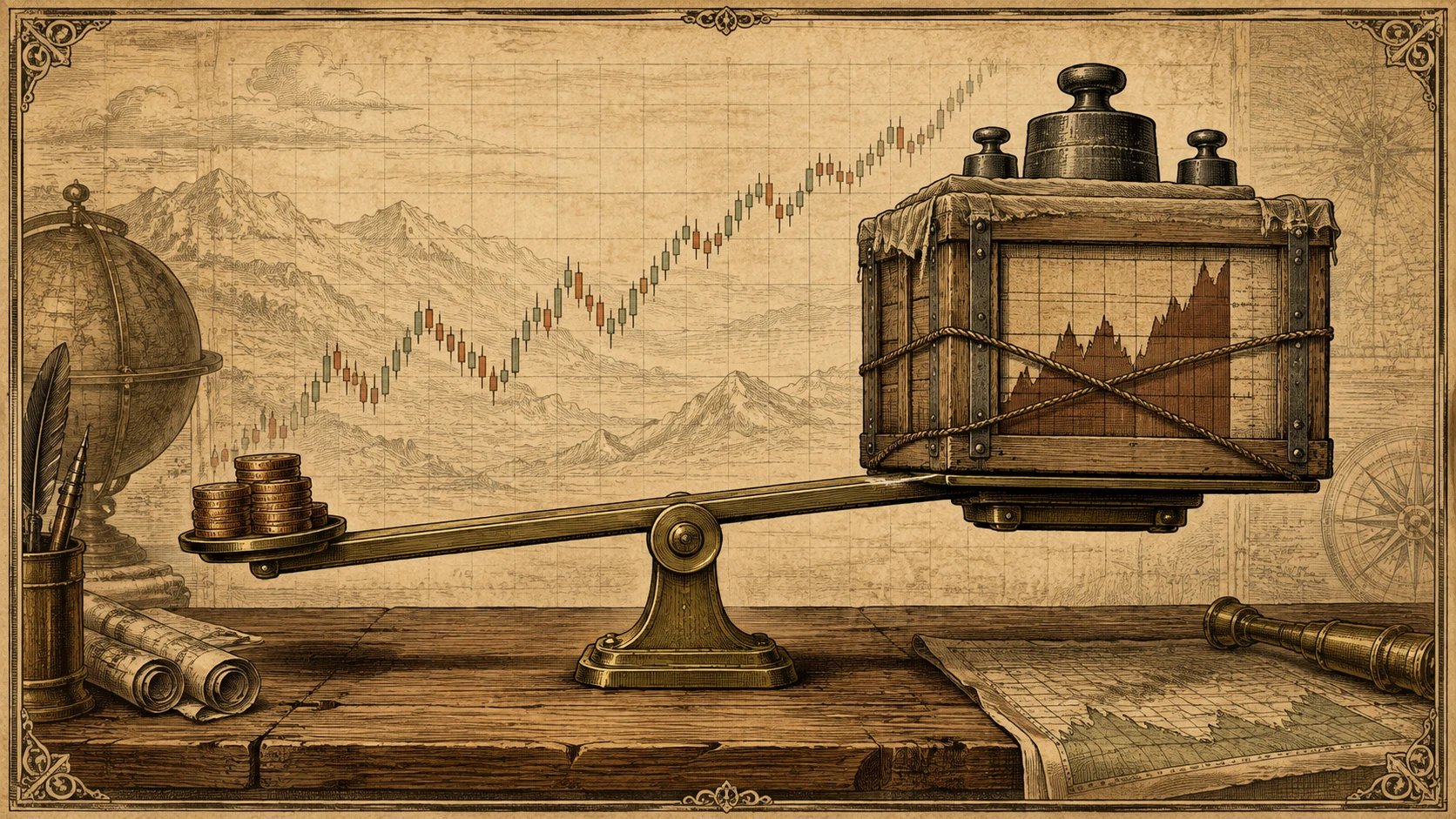
Leverage is one of the most widely used concepts in trading, but it is also one of the most misunderstood. It can increase your market exposure without requiring the full value of a trade upfront.
However, leverage does not reduce the risk of a trade. It increases both potential gains and potential losses.
Understand the core mechanics of margin and borrowed exposure before executing your first trade.
Leverage lets you control a larger position with less capital, magnifying gains and losses alike. It is borrowed exposure, not free money. Before using it, understand margin, liquidation, position size, and how much you could lose if price moves against you.
What Is Leverage in Trading?
When you trade with leverage, your broker lets you open a position larger than the cash you put down. You provide a fraction of the total value — the margin — and the broker effectively lends you the rest of the exposure.
Leverage is expressed as a ratio, such as 5:1, 10:1 or 30:1. The higher the ratio, the less capital is required to control the same position.
How Does Leverage Work?
The relationship between your capital, the leverage ratio, and the position size follows a simple formula: position size divided by leverage equals the margin required.
Suppose you want to open a position worth $10,000. With leverage of 10:1, you only need $1,000 of your own capital to open the position.
- Decide the position size you want to open.
- Check the leverage ratio your broker offers for that market.
- Divide the position size by the leverage ratio to find the margin required.
- Confirm you have enough free margin in your account before placing the trade.
Leverage Example
Leverage magnifies whatever the market does next, in both directions:
| Scenario | Market movement | Result without leverage | Result with leverage |
|---|---|---|---|
| Price rises | +2% | Small profit | Larger profit |
| Price falls | −2% | Small loss | Larger loss |
The same leverage that increases your potential return also increases your potential loss.
If the market moves against your position, leverage can cause losses to accumulate quickly. In some situations, your position may be closed automatically when your available margin becomes too low.
Benefits and Risks of Leverage
Leverage is a trade-off. Weigh what it adds against what it exposes you to.
Potential benefits
- Greater market exposure
- More efficient use of available capital
- Ability to trade different markets
Potential risks
- Larger losses
- Faster account drawdowns
- Margin calls or automatic liquidation
- Greater emotional pressure
New to trading?
Learn the essential concepts of leverage, margin and risk management in our beginner trading course.
How Much Leverage Should Beginners Use?
There is no single leverage ratio that is suitable for every trader. Beginners should generally focus on using lower leverage, smaller position sizes and clear stop-loss levels.
Using the maximum leverage available does not mean you should use it on every trade.
How to Manage Leverage Risk
Managing leverage risk comes down to controlling your position size and following a clear risk management plan.
- 1Start with lower leverage
- 2Use a stop-loss
- 3Keep position sizes small
- 4Avoid risking too much on one trade
- 5Understand margin requirements
Leverage is a tool. Whether it is useful or dangerous depends on how it is used.
Key takeaway
Frequently Asked Questions
Is leverage good for beginners?
Leverage can be appropriate for beginners in small amounts, but it is not required to start trading. Many beginners choose to trade with low or no leverage while they learn how markets move and how to manage risk.
Can you trade without leverage?
Yes. Trading without leverage means you only control the amount of capital you deposit. It removes the risk of margin calls, though it also limits the size of the positions you can open.
What does 10:1 leverage mean?
A 10:1 ratio means you can open a position ten times larger than your own capital. For example, $1,000 of your own money can control a $10,000 position.
Can leverage cause you to lose more money?
Yes. Leverage multiplies both gains and losses. A small adverse price move can result in a loss that is significantly larger than it would be without leverage.
What is the difference between leverage and margin?
Leverage is the ratio that determines how large a position you can open. Margin is the amount of capital you must set aside to open and maintain that position.