
New traders frequently confuse Limit Orders and Stop Orders, often wondering why a broker rejected their order or why a buy order filled at a price much higher than expected.
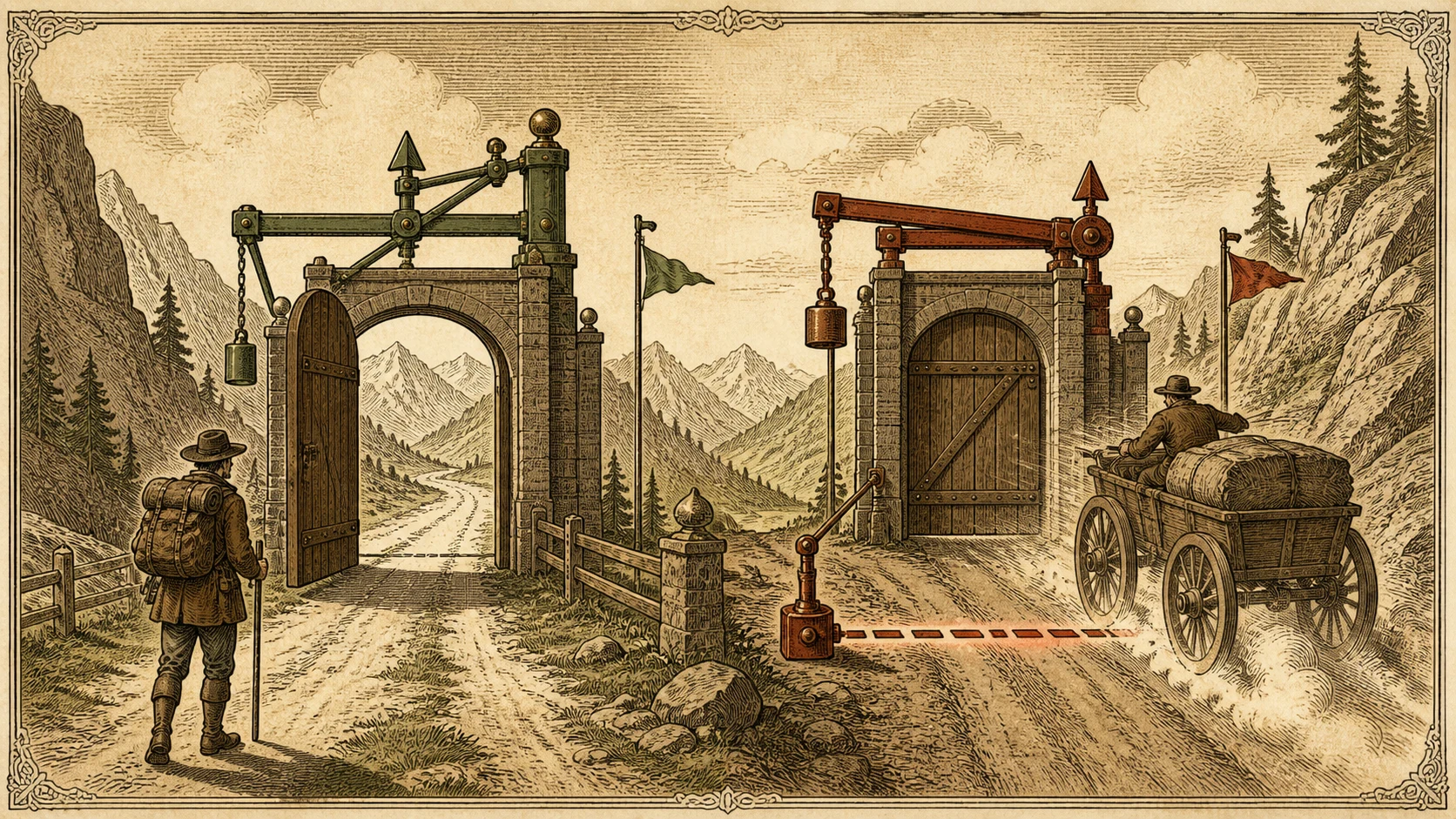
The confusion comes from a simple misunderstanding of market direction: a limit order is designed to capture a better price by waiting passively below market (for buys) or above market (for sells), whereas a stop order lies dormant until price crosses an aggressive threshold, springing to life as an active market order.
Using the wrong order type can invert your entire trading intent. Here is how their mechanics and trigger conditions fundamentally differ.
Limit orders post visible bids or offers directly into the order book, guaranteeing execution at your specified limit price or better (passive price boundary). A stop order becomes an executable order after its trigger condition is met; the trigger price is not a guaranteed fill price. Once triggered, a standard stop-market order executes against prevailing market liquidity, but execution speed and price depend on available order depth.
| Dimension | Limit Order | Stop Order |
|---|---|---|
| Core Nature | Price boundary (guarantees price or better) | Conditional trigger (converts to market order when reached) |
| Book Visibility | Resting visibly in the public order book | Dormant until trigger criteria are met |
| Buy Placement | Placed BELOW current market price | Placed ABOVE current market price |
| Sell Placement | Placed ABOVE current market price | Placed BELOW current market price |
| Execution Guarantee | Guarantees price boundary if filled; no guarantee of execution | Becomes executable once triggered; fill price is not guaranteed |
| Primary Application | Buying pullbacks, selling into strength | Defensive stop losses, breakout momentum entries |
Where Do They Sit Relative to Current Price?
The easiest way to master the difference is to visualize current market price as the floor of a room:
• Buy Limit (Below the Floor): You want to buy at a discount. Current price is $100; you place a Buy Limit at $95. You are telling the exchange: 'Only fill me if the market drops to $95 or cheaper.'
• Buy Stop (Above the Ceiling): You want to trade a breakout. Current price is $100; you place a Buy Stop at $105. You are telling the broker: 'Do nothing right now. But if bulls push price up through the $105 resistance, immediately wake up and buy me in at whatever market price is available.'
A Stop-Limit order combines both concepts: it uses a Stop Price as the trigger mechanism, but once triggered, it converts into a Limit Order rather than an aggressive Market Order. This protects you from catastrophic gap slippage, but reintroduces non-execution risk if the price blows past your limit threshold.
When Should You Use Each Order?
• Use a Limit Order when: You are accumulating shares on a dip, taking planned profits at target resistance, or trading within an established consolidation range.
• Use a Stop Order when: You need an automated line in the sand to terminate losing trades (protective stop loss), or when you want to buy into confirmed upward breakout momentum above key chart levels.
Frequently Asked Questions
What happens if I place a regular limit buy above the current market price?
If you place a limit buy at $105 when the market is trading at $100, the exchange will immediately match your order at the prevailing $100 market price, because $100 is 'better' than your $105 limit. To wait for $105 before buying, you must use a Stop order.
Can a stop order trigger during after-hours trading?
By default, most equity stop orders only trigger during regular market hours (9:30 AM to 4:00 PM ET in the US) to protect traders from wide erratic spreads. Check your broker's extended-hours routing settings.
Why did my sell stop fill at a price lower than my stop price?
Because a stop order turns into a market order upon triggering. If the market gaps down or experiences sharp selling velocity, the next available fill price can be well below your trigger price.