
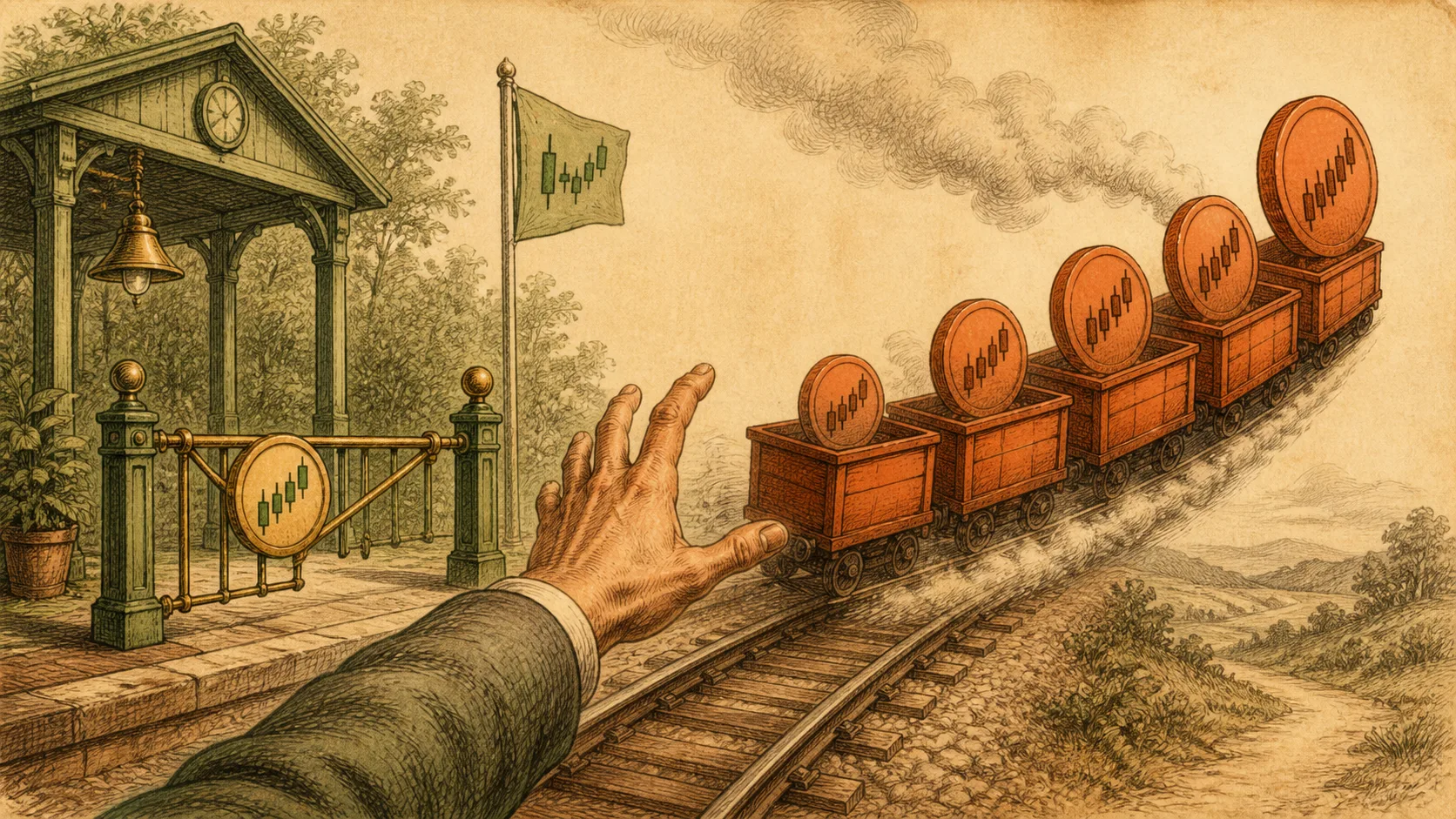
You watch an asset rally for an hour without being in it. Every candle feels like money leaving the table. Finally you click buy near the top of the move, without a plan, because the alternative feels worse.
That is FOMO trading: entering primarily because price already moved, not because an independently valid setup just appeared. The move that happened is not evidence about what happens next.
FOMO trading is entering because price already moved and you fear missing further gains. The move that already happened is not evidence about what happens next, and chasing it skips the original plan entirely. The defense is a pre-written entry rule and a pause: name the feeling, check for a new setup, compare to the plan, slow down.
The Core Pattern of FOMO
The tell of FOMO is the source of the decision. A plan-based entry starts from an independently valid reason: a rule fired, an invalidation was set, the setup matches the criteria.
A FOMO entry starts from the market's recent action: it went up, so you want in. The rally is treated as if it were new information about the next move, when it is information about a move that already finished.
What FOMO Costs You
Entering at the top of a move without a plan means no invalidation level, no defined risk, and no size that was solved from either. The position is a reaction, so every subsequent decision about it is also a reaction.
It also trains a bad loop: each chase that briefly works rewards the behavior, making the next chase larger. The few times it pays reinforce the habit that usually loses.
| Dimension | Plan-based entry | FOMO entry |
|---|---|---|
| Source of decision | An independently valid setup | A move that already happened |
| Has a defined stop | Yes, set before entry | Usually not |
| Size from risk budget | Yes | Chosen by urgency |
| What happens if it works | Reinforces a repeatable rule | Reinforces chasing |
How to Stop Chasing
Write the entry rule before the session and keep it visible. When the urge to chase appears, treat the missed move as a completed event, not a reason to act now.
Ask the four questions before overriding the plan: name the feeling, check for a new independently valid setup, compare to the written plan, and slow the decision down. If there is no new setup, there is no trade.
| Step | Plan-based trader | FOMO trader |
|---|---|---|
| Price rallies $50.00 → $58.00 | No valid setup yet, stays out | Chases the top, buys 100 sh at $58.00, no stop |
| Price pulls back to $52.00 | Enters 100 sh at $52.00 on the retest, stop at $50.00 | Panics, exits 100 sh at $52.00 |
| Price recovers to $57.00 | Still in the trade, unrealized gain | Already out, missed the recovery |
| Result on 100 shares | +$500.00 unrealized (+9.6% on $5,200 cost) | −$600.00 realized (−10.3% on $5,800 cost) |
Hypothetical price path for illustration; not a real security or a prediction of how any market will move.
Both traders watch the same rally from $50.00 to $58.00. The FOMO trader buys the top with no stop because the move feels too strong to miss, and gets shaken out at $52.00 for a $600.00 loss (−10.3%) on the very next pullback. The plan-based trader had no valid setup at $58.00 and stayed out, then bought the $52.00 retest with a defined $50.00 stop. By the time price recovers to $57.00, that trade shows a $500.00 unrealized gain (+9.6%) — a roughly $1,100 swing between the two decisions, on the same price path.
'Price already moved' and 'a new setup just appeared' are different claims. Only the second one is a reason to enter a trade.
When a Re-Entry Is Legitimate
Re-entering after a move is not automatically FOMO. It is FOMO when the decision comes from missing out. If a rule you wrote in advance fires after the move, and the setup is independently valid, that is a plan working.
The test is the same as ever: does the decision come from the plan and a new setup, or from the feeling of missing the move?
Frequently Asked Questions
Is every late entry FOMO?
No. A late entry can be a plan-based trade if a rule fired and the setup is independently valid. FOMO is defined by the source of the decision, not the timing.
Why does FOMO feel so strong?
Watching a move you missed feels like a loss. The feeling is real, but it is not evidence about the next move.
What should I do when I feel the urge to chase?
Name the feeling, check for a new independently valid setup, compare to the written plan, and pause. No new setup means no trade.