
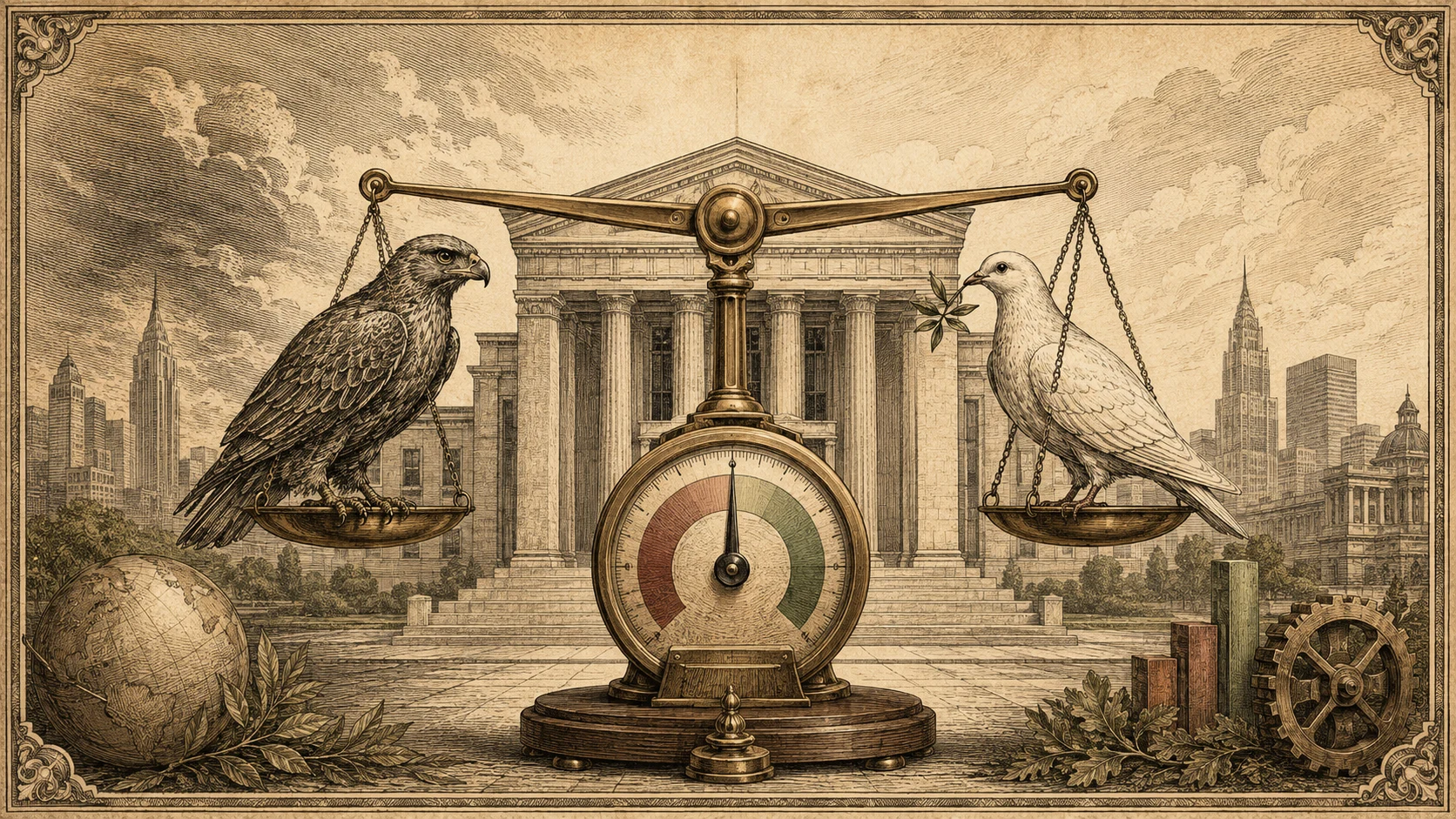
Financial news constantly labels central bankers as either 'hawks' or 'doves'. Headlines treat these animal metaphors as binary buy or sell switches: hawks supposedly crush stocks by raising rates, while doves provide endless monetary fuel for rallies.
In reality, hawkish and dovish describe a policymaker's balance of priorities between two competing mandates: price stability and maximum sustainable employment. Understanding this spectrum is essential for decoding policy statements without falling into simplistic directional bets.
Hawkish policymakers prioritize controlling inflation by keeping interest rates restrictive and liquidity tight. Dovish policymakers prioritize employment and economic growth by keeping rates low and credit accessible. Neither stance is a mechanical trading signal; markets move on shifts in the projected policy path, not the static label itself.
The Policy Spectrum: Inflation Defense vs Economic Support
Major central banks operate under legislative mandates. For example, the US Federal Reserve has a dual mandate: price stability (typically a 2% annual inflation target) and maximum employment. Other institutions, such as the European Central Bank, have a hierarchical single mandate centered strictly on price stability.
When inflation rises above target, policymakers lean hawkish. They tolerate slower economic growth or even rising unemployment to prevent inflation expectations from becoming entrenched. Conversely, when economic activity slows, unemployment rises, or deflation looms, policymakers turn dovish, reducing borrowing costs to stimulate credit creation and business investment.
Crucially, a policymaker is rarely permanently hawkish or dovish. Most are pragmatists who shift along the spectrum depending on where the incoming macroeconomic data stands relative to their targets.
| Dimension | Hawkish Stance | Dovish Stance |
|---|---|---|
| Primary Objective | Control inflation and prevent economic overheating | Support labor markets and stimulate economic growth |
| Interest Rate Bias | Higher for longer; inclined to raise or hold restrictive rates | Lower for longer; inclined to cut or hold accommodative rates |
| Balance Sheet Stance | Quantitative tightening (letting bonds mature or selling assets) | Quantitative easing or expanding liquidity facilities |
| Short-Term Bond Yields | Upward pressure as rate expectations rise | Downward pressure as funding costs ease |
| Currency Impact | Often strengthens the domestic currency via higher yields | Often weakens the domestic currency as yield differentials narrow |
| Equity Valuation Impact | Compresses valuation multiples via higher discount rates | Supports valuation multiples through lower borrowing costs |
Observed market reactions depend on what was already discounted. A hawkish statement can still cause yields to fall if the market had anticipated an even more aggressive stance.
How Markets Gauge Tone: Statements, Forecasts, and Press Conferences
Central banks communicate their stance through three distinct layers during a scheduled policy meeting:
The Official Policy Statement: Every word is scrutinized. Changing a phrase from 'additional firming may be needed' to 'the committee will assess the extent of future policy adjustments' can represent a decisive shift toward neutral without altering current interest rates.
Economic Projections and Dot Plots: Quarterly economic forecasts show where voting members see rates, GDP growth, and core inflation over the next three years. If the median projection for the terminal rate drifts upward, markets register a hawkish revision even if current rates remain frozen.
The Press Conference Q&A: The central bank chair provides qualitative context during the live press conference. A single unscripted phrase—such as acknowledging that 'the policy rate is well into restrictive territory'—can undo an ostensibly hawkish written statement within seconds.
A central bank keeps its benchmark rate unchanged at 4.50%, matching consensus forecasts. However, the accompanying statement notes that 'inflation risks remain tilted to the upside', and the updated projections remove two previously projected rate cuts for the following year. While the headline was 'rate hold', the message was decidedly hawkish, pushing 2-year government bond yields higher immediately.
Three Misconceptions That Trip Up Beginners
Trap 1: Assuming Hawkish Equals an Immediate Hike. A hawkish central bank may hold rates steady for multiple consecutive meetings if it believes existing policy is sufficiently restrictive. The stance describes the inclination and risk balance, not the calendar timing.
Trap 2: Treating Stances as Permanent Personalities. Commentators frequently label specific governors as 'eternal hawks' or 'staunch doves'. However, structural regime shifts (such as a sudden inflation surge or banking liquidity squeeze) force even the most predictable officials to pivot.
Trap 3: Ignoring the Baseline Expectation. If investors enter a meeting expecting an ultra-hawkish announcement (e.g., a 50-basis-point hike) and the bank only delivers a 25-basis-point hike with balanced remarks, the outcome is functionally 'dovish relative to pricing'. Asset prices will rally even though the bank formally raised rates.
- I checked the market's pre-meeting implied probability distribution, not just the base forecast.
- I compared changes in the official statement text relative to the previous meeting's version.
- I evaluated whether dot plot median estimates moved higher or lower for future years.
- I listened to whether the press conference confirmed or softened the written statement.
- I noted whether voting members dissented against the majority decision.
Frequently Asked Questions
What is a 'dovish hike'?
A dovish hike occurs when a central bank raises rates but pairs the decision with soft language, signaling that this was likely the final hike of the cycle or that economic concerns will soon pause further tightening.
Can a central bank sound hawkish and dovish in the same meeting?
Yes. For example, a central bank might sound hawkish about sticky services inflation while simultaneously expressing dovish concern about weakening consumer spending or commercial real estate credit.
Why do currency traders care so much about hawkishness?
Currencies are heavily driven by short-term interest rate differentials. When a central bank signals a more hawkish path than its peers, international capital often flows toward its higher-yielding money-market instruments, supporting the currency.